

Be a Hero – Teach a Child to Read!
The Alpha-Phonics Blog

Learning to Play Again - Adding Imagination to your Home-schooling

Prior to the electronic invasion of our homes, it was not uncommon to encounter a wide variety of play activities. Building blocks, paper airplanes, trains made from cardboard boxes, paints and crayons, dress-up wardrobes, Fisher Price’s Little People sets and more. I think it’s time to bring these activities back into our homes!
Imagination, creativity, social and emotional development, language and communication skills, thinking, learning and problem solving, and physical development, are among the benefits of pretend play.
Five reasons to encourage pretend play
Source: Therapies for Kids Website
“Pretend play, it seems, is under attack from a fast-paced digital world. Maybe it’s time to start changing that.”
1. To encourage imagination & creativity
Builds a child’s ability for flexibility and then creativity.
How to think for themselves.
Helps children understand another point of view.
2. Supports social & emotional development
As they pretend to be different people or control objects, they are practicing social and emotional roles of life.
They learn how to walk in someone else’s shoes – often mum or dad.
Develop self-esteem and self-awareness.
Learn how to recognize and respond to others feelings when involved in group imaginary activities.
3. Improves language and communication skills
They learn new language that they might not encounter every day.
It’s fun and provides opportunities for discussion.
Gives them control and can help decrease anxiety as language becomes more familiar.
They have to communicate their thoughts to others – an essential social skill.


4. Develops thinking, learning, and problem-solving
By the nature of pretend play, children are presented with problems and scenarios to solve or plan.
How to cope/change when something doesn’t go to plan in a game.
Develop their memory.
Abstract thinking – when an object/person takes on a different meaning.
5. Enhances physical development:
Often physical – e.g. being an aeroplane, climbing ladders as a fire fighter, etc.
Fine motor skills developed while feeding and dressing a doll.
Learning about rough and tumble and limits.


How to encourage pretend play:
Play together face to face so your child can copy your gestures/pretend actions.
Follow your child’s lead – play with things your child is interested in.
Keep it simple – repetition is fun.
Take turns – the play becomes a “conversation.”
Choose the right toys.
Introduce new ideas when they can link ideas together – e.g. if they like to play with cars, take them to the mechanic.
Benefits of pretend play:
Allows you new ways to connect with your child
You can follow their lead and join in with their interests.
Motivating and connecting for all involved.
Helps your child think symbolically.
Develops critical thinking.

Toys for pretend play:
Vehicles (not just for boys!)
Common in children’s lives – so good for simple pretend.
They can put a driver in and go to the mechanic.
Use a shoe box to make a car/bus.
Playdough – In early play, make simple/familiar objects. Later, make food for the tea set, make roads, etc.
Costumes and props – old hats/shoes/scarves/coats. Bags/briefcase/boxes for store/shop, etc.
Favorite stuffed animal or doll – great for feeding and pretending real life situations.
Puppets – moving parts help them come to “life.”
Encourages joint/peer play in older children.
Blocks and Lego – initially might build simple and familiar objects (e.g. house/car). Later might “pretend” that individual blocks are something real (e.g. a bed/food for animals, etc.).
Toy food/dishes/groceries – initially feed the animal, later then a restaurant, have a tea party.

The Science of Reading – Why we Should Read to our Children

Build Vocabularies: Words are for Thinking!
When you have an idea, do you have enough words to express it?
If you need a new word, where do you find it?
If you answered that you “just know it from memory,” then how did it get into your brain’s word memory bank?
The truth is, words need to be taught. During the earliest years of life, children are listening and learning, even before they are born. They are being taught by environmental sources of language – people, news channels, game videos – or from wherever words are being spoken. The more words children hear, the more words they will ultimately use when reading, speaking and writing. The type of words children learn will affect the audiences they will be able to address without criticism.
Children who sit quietly and listen during adult conversations will benefit by gaining specialized vocabularies related to the particular interests of those adults. Children who sit alone, listening to electronic devices, will be impacted in either positive or negative ways depending on what they are listening to.
This information, alone, should cause us to care about what words our children are exposed to. What are they hearing? What are they learning? What will they be saying?
Neuroscience Guides Vocabulary Acquisition and Usage

According to the French neuroscientist Stanislas Dehaene, reading bedtime stories to children, beginning from toddlerhood and continued through their growing-up years, strengthens their brain circuits for language and helps them learn to understand texts and formulate complex thoughts.
(Dehaene has spent several years studying the results of fMRI scans and has reported back to the world at large about how the brain reads. His discoveries have changed how we think about the child’s acquisition of language and how it impacts the ability to read. Dehaene also recommends reading to the child in the womb. According to Dehaene babies are born with a preference for listening to their native language which he says implies that language learning starts in the womb.)
Cultural Activities and Traditions
Fingerplay, Nursery Rhymes and Children’s songs are often passed down through families from grandparents, aunts and uncles, and other loved ones.
Some children’s songs have dances that go with them. When movement is added to the human interaction, the benefit of multisensory activities on the brain is added to the mix.

Research from the University of Melborne
A group of scientists (University of Melborne: Department of Education and Early Childhood Development) have recently reported what they learned when examining the impact of a person’s early exposure to words. I recommend reading this report, but for now here are two key facts from their findings, published online at: Reading to Young Children: A Head-Start in Life
A Direct Effect on School Outcomes:
“The frequency of reading to children at a young age has a direct causal effect on their schooling outcomes regardless of their family background and home environment.”
Higher Achievement Scores:
“Children read to more frequently at age 4-5 achieve higher scores on the National Assessment Program – Literacy and Numeracy (NAPLAN) tests for both Reading and Numeracy in Year 3 (age 8 to 9)
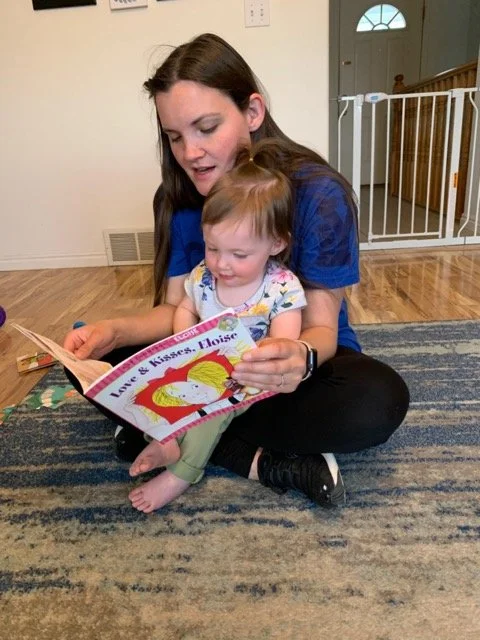
Child listening to her mom read
Impacting Young Minds is in Our Hands
The science references in this short blog should be enough to convince us of how great an influence we have when we interact with children. Even if we don’t have children of our own we can wield that influence by volunteering in our communities. New readers are always in need of someone they can read to. We can be those someones. Volunteer!
If you don’t read with the children of our community, who will?

The Special Reading Group & Phonics Cards for Christmas?

In 1955 Rudolf Flesch published his book, “Why Johnny Can’t Read”. He blamed the reading programs of the day. He explained that English is an alphabetic language, and that in order to learn to read efficiently students must learn to “sound out” words rather than merely recognize them at sight. His book included a note to mothers – encouraging them to teach their children to read – and word lists in the back of the book, which they could use to do so.
The book sparked a rebirth of what is known as the reading wars. Educational Journals fought back with many articles in defense of the new methods and harsh criticisms of phonics.
Anna Gillingham, a reading teacher/psychologist of the day, (known for her affiliation with the renowned reading scientist Samuel T. Orton) responded to journal debates with a letter to the editor in the 1958 edition of Elementary Education.

Anna Gillingham
Here is an excerpt from that letter. It describes an unexpected response from general education students – when they saw how the at-risk students were being taught to read. It had become evident to them that the phonics-first approach to teaching reading was more successful than the whole-word approach – which was being used in the regular classrooms.
To the Editor —
“… Twenty years ago as a pioneer, I was experimenting with the selection of kindergarten children who would probably have trouble with reading, unless taught by the technique already found successful with older remedial pupils. I shared the anxiety of many teachers and parents, that being set apart in a special group would cast a stigma upon its members. However, by the time the experiment had been tried for two or three years, we found our fears groundless.”
General Education Students Asked to Join Remedial Group
“Instead of resenting the placing of their children in a separate group, mothers came and asked for the privilege of having their children taught as a cousin or neighbor had been taught last year, “because he learned so much better.”
“Instead of looking with scorn or ridicule upon their classmates sent out for this special kind of reading, the class manifested envy as of a privileged group. Children asked, “Miss Blank, am I going on this same way with you next year? It’s a lot nicer than what the other children are having.” By the time the project was in its third year, the rest of the class began to recognize the advantage the special group was experiencing. A third grade boy said, ‘kids learn a great deal that we don’t know. We know a lot of words, but when we don’t know a word we have to ask, but they can work it out for themselves.'”
““Another third-grade boy who had always read fluently in the SightWord reading group, asked his teacher wistfully, ‘If I read this very well, may I go with Miss Blank’s class? Those children in that special group know so much more.’””

Reading class in a one-room schoolhouse
“Children asked their mothers, and mothers asked us, what could be done so that all might receive the privileges of the Special Group.
A fifth grade girl, who was an excellent speller, was excused from the class with two other children to work on a delightful art project. Meanwhile, her entire class was having spelling by the Gillingham Technique. Technique. After a few days she went to the teacher with the request, “I can do this painting at home.”
““‘Mayn’t I please be in the class for spelling? It is so much fun to learn the rules and the history of words and all the rest that we have been doing. It is so much nicer to know the reason than just to remember the spelling of words and not be sure that we are remembering them correctly or why they are that way.’””
Wanting to Practice Drills
“Numerous similar expressions could be quoted from all the schools in which the experiment has been tried. Pity was felt by some teachers for the children of the Special Group who must go over and over the dull [phonics] Drill Cards.”
“To the astonishment of these critics, however, there were protests by the children if, for any reason, the Cards were omitted on a particular day. To the genuine surprise of the teachers, parents not infrequently asked to buy the Cards because the child wished them for Christmas or birthday, or, ‘so that I can teach my cousin, because in his school they don’t have them. He doesn’t know the sounds!’

Rudolf Flesch, Lesson 1 from “Teaching Johnny to Read”
“Those teachers learned a lesson greatly needed in many other fields, namely, that it is the teacher and not the pupil who is bored by drill and repetition. The child feels delight in definite progress in which he can see tangible evidence of success. ‘See me gain, see me gain!’ exulted one child.
“Recently I had the privilege of observing a second grade selected group being taught by the Alphabet Approach. They had been clamoring for a new diphthong Card for which the teacher had declared them not yet ready. On this day she announced that they might have it. ‘And it is a tough one!’ she warned. Hands were noiselessly clapped and several youngsters joggled up and down in their seats. ‘May I try it, may I try it?'”
[Yes, you read that correctly. Anna Gillingham’s “special group” became the preferred group. The students themselves saw the benefits of being in the remedial group. One of the boys discovered that when he wanted to know a word, he needed to ask. When the others wanted to know a word, they were able to figure it out themselves. This is because they had learned how to read by the alphabetic method, as Anna Gillingham called it. In her editorial she goes on to explain what she means by phonics and she tells how the meaning of the word phonics, within the process of teaching with the whole word method, had changed.]
Misusing the Word Phonics
“Another point which should be made clear in the mind of any teacher attempting to use my technique is the distinction between this approach and what is usually accepted as ‘phonics.’
“Teachers not infrequently tell me that they are using my method, that they “always did believe in phonics.” They usually mean “analytical” or “functional” phonics. By this method several words are taught from one of the delightful primers that have been carefully constructed to introduce the same word in a good many situations [whole-word primers]. After a considerable number of words (perhaps one hundred) are recognized on sight, they are gradually broken down into their phonetic units. In the hands of a skilled teacher this, the current method, attains apparently satisfactory results with many pupils. Others fail because they cannot learn the preparatory group of sight words. Whether or not this method is desirable is a matter of opinion. The positive statement to be made here is that this method of teaching phonics is not to be confused with the Gillingham Technique [Alphabetic Approach].”
The Sight-Word Method vs the Alphabetic Approach
“The Sight-Word Method and the Alphabetic Approach are based upon two distinct and mutually exclusive concepts. When men first began to attempt to communicate with each other at a distance by written messages, they drew pictures. Their communications were, in fact, pictorial narratives. Gradually these pictures became conventionalized into characters bearing less and less resemblance to objects. Thus we find Chinese characters and Egyptian hieroglyphics, each standing for a word or even for a phrase or short sentence. There are many words in any language and a scholar who had many ideas to communicate had to learn many thousands of ideograms – a laborious task.”
Using Letters to Represent Sounds
“About three thousand years ago it dawned upon some genius or group of geniuses in the Eastern Mediterranean region that it would be easier to have a character (letter) stand for a speechsound. Then these letters, few in number (English has 26), could be combined and recombined thousands of times to form words. As long as a language developed by itself, it was perfectly phonetic. It was only when two languages mixed through conquest or migration that there came to be silent letters or more than one sound for a letter, or more than one letter for a sound. This general approach to written language prevailed in Europe and in America until something less than one hundred years ago. It is upon this concept of combining letters to form words that the Gillingham Technique is based.”
““Flesch explained that in the early 1930s, the professors of education changed theway reading was taught in American schools. They threw out the alphabetic phonicsmethod, which is the proper way to teach anyone to read an alphabetic writing system,and they put in a new whole-word, look-say, or sight method that taught children toread English as if it were Chinese, an ideographic writing system. Flesch explainedthat when you impose an ideographic teaching method on an alphabetic writingsystem, you get reading disability.””

Samuel Blumenfeld
Author of “Is Public Education Necessary”
“N.E.A. Trojan Horse of American Education”
“Alpha-Phonics”
Gillingham Editorial (continued):
Returning to Ideographs
“Late in the 19th Century there came a return to the ancient ideogrammatic concept. A word was to be learned in its totality as an ideogram, disregarding the letters of which it was composed. In the extreme form of this method the letters are not learned at all. This Sight-Word Approach swept over America and has worked havoc: with reading and spelling. Several of my older Remedial Reading pupils have told me gravely that until they had learned my Drill Cards, they had no idea that the letters in a word had anything to do with its pronunciation! Here we have a clear demonstration of the mutual exclusiveness of the two concepts.

“A pupil who is trying to remember a certain word as an ideogram cannot at the same time be sounding the letters in series to work out the pronunciation of the word. He may remember the wrong word, just as I may confuse the names of Mrs. Jones and Mrs. Smith met at a tea. Such a pupil may say garden for basket (both words having been previously encountered in the same story), or bird for robin (words seen as labels to pictures).
“The value of introducing phonics while the child is being exhorted to remember words as sight units is controversial, but such an introduction of the sounds of the letters as an aid to learning words as ideograms must not be confused with the Alphabetic Approach.
“And now we come to my last point. It seems to me important that teachers interested in my technique should be made familiar with trends in the widening application of the Alphabetic Approach.”
Why not just teach words as ideograms?
“At least a dozen years ago teachers began to inquire, ‘Since this Alphabetic Approach is the means of saving from failure those who would otherwise have failed, or is the best Remedial Technique for those who have already experienced the frustration of failure, why would it not be the best way to teach all children?’ For some time my voice gravely joined the chorus of conventional answers. ‘If a child can learn to recognize ideograms (Sight-Word Method), he should have the privilege of learning this way. The Alphabetic Approach would slow down his potential speed.'”
“But as the years went by I wondered more and more. This was not a flippant question. It was asked by some of our best and most experienced teachers. For example, Mary Davidson, former head of the Primary Department of the Fieldston Lower School in New York, asked it with purposeful interest, and is now using the Alphabetic Approach with whole classes in the Oakwood School in North Hollywood, California.


“More and more emphatically it was forced upon my attention that there is no sharp line between the potential reading failure and the child who learns with a slight degree of success. If the Alphabetic Approach is necessary for Jimmie, why is it not good for Harry whose test results show only a slight difference? With the almost universal uproar about poor spelling, we can afford to give some training in the kinesthetic and auditory aspects of the language pattern at the beginning. Only a few supernormal children never misspell. These are too few in number to have a school policy made for them. Experience proves more and more that the Alphabetic Approach is slower for only the first weeks or very few months. After that, the progress of children thus taught is often more rapid than that of their Sight-Word Method classmates. Since there is no sharp line between the children supposed to need the Alphabetic Approach and those for whom the Sight-Word Method is preferable, it begins to appear that the Alphabetic Approach may eventually come to be regarded as best for all…”
Signed — Anna Gillingham
This editorial was reprinted in Samuel Blumenfeld’s book, The New Illiterates and How to Keep your Child from Becoming One. This book was recently reprinted by Paradigm Books and is available on Amazon, along with Blumenfeld’s primer: Alpha-Phonics: A Primer for Beginning Readers.
Samuel Blumenfeld uses the alphabetic method as it is described by Anna Gillingham. The Blumenfeld primer provides word lists which introduce the sounds of the letters and combine them systematically into words. The lists replace the drill cards which Anna Gillingham mentions in her editorial.
Edited by Meg Rayborn Dawson (homeschooling mom of 9) author of: Dyslexic No More: Saved by the ABC’s

Inventing the Alphabet – A Sound Symbol System of Writing

Why is Phonics Called Phonics & What Does This Have to do With Reading Instruction?
It is not difficult to guess that the word phonics is connected to the Phoenicians, but what is the significance of this and how does it apply to reading instruction?
(Samuel Blumenfeld, author of Alpha-Phonics: A Primer for Beginning Readers gives this short but concise account of the history of the alphabet, which he gleaned from the work of Dr. Mitford M. Mathews, author of A Dictionary of Americanisms on Historical Principles (1951) and editorial consultant for the Webster’s New World Dictionary from 1957 to 1981.)
The alphabet was invented by the Phoenicians over three thousand years ago. The Phoenicians, who lived in the area we now call Lebanon, spoke a Semitic language and were neighbors of the Greeks with whom they traded.
The Phoenicians used their writing system to help record many of their commercial transactions. The Greeks were intrigued by the facility acquired by the use of a sound-symbol system, and they tried to use it for their own language.
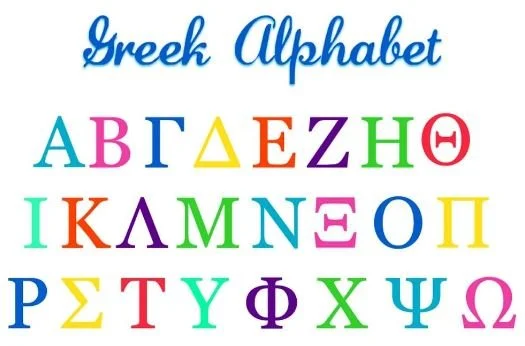
But Greek was quite different from Phoenician in its sounds, and it took a great deal of experimentation before the Greeks devised a complete set of symbols or letters with which they could represent every sound of their language.
To facilitate the learning of the alphabet, each letter was given a distinct name, borrowed from the Phoenicians in most cases, in which the sound of the letter was given. Thus, we got alpha, beta, gamma, etc. The important point to note here is that the name of the letter was quite distinct from the letter’s sound value, and there was no confusion in the minds of the Greeks about the two.

Athens education
In those days there was no such thing as a dictionary or spelling guide. This was long before printing. If you knew the alphabet and wished to use it, you simply sounded out each word you wanted to write and then set down the letters representing the sounds in the same sequence as the sounds themselves were uttered. This seems like so obvious a procedure, yet two thousand years later we shall find professors of education doubting its simple validity. At first, you used the alphabet in any direction you wanted. The Phoenicians wrote from right to left as do those who write Hebrew today. But eventually the Greeks settled on a left-to-right direction.

Egyptian hieroglyphics
Before the invention of the alphabet, writing was ideographic. Language was represented by picture-symbols which required a great deal of memorization and was never very accurate. It was easy enough to represent commonplace objects and simple actions by picture symbols. But when it came to communicating complex philosophical abstractions or great subtleties, ideographs were inadequate. The alphabet was a tremendous improvement. Once you mastered the sound-symbol system, you could write down any thought in precisely the manner you wanted it to be conveyed. This enabled the Greeks to expand the mind’s capacity to think and work, and it permitted a tremendous advance in man’s intellectual development.
According to Dr. Mitford M. Mathews:
““Other peoples, such as the Babylonians and the Egyptians, had caught glimpses of the desirability of having signs represent sounds, not things, but they were never able to break with convention to the extent of setting aside picture writing in favor of letter writing. The fundamental defect of picture writing was that it was not based upon sounds at all. Greeks saw this basic weakness and by avoiding it achieved everlasting distinction.””
How were the Greeks able to “break with convention”?
Dr. Mathews continues:
“The secret of their phenomenal advance was in the vividness of their conception of the nature of a word. They reasoned that words were sounds, or combinations of ascertainable sounds, and they held inexorably to the basic proposition that writing, properly executed, was a guide to sound.”
Perhaps this is one reason why the Greeks produced such great dramatists: their infatuation with and love of the spoken word, and their determination to capture it as accurately as possible for themselves and future generations. It is worth noting that much of the ancient Greek literature we enjoy today was written in the form of dialogues.

Renowned Author Recommends Alpha-Phonics – Donna Fletcher Crow Interview

Donna Fletcher Crow
“Alpha-Phonics is honored and proud to list among its friends the well-known author Donna Fletcher Crow. Mrs. Crow’s impressive bibliography lists more than 50 books, mostly mysteries and historical fiction and most of those taking place in England. Her most recent, Glastonbury, is a tale of the Holy Grail and may prove to be her most popular ever. Recently we were able to discuss with her the role Alpha-Phonics played in teaching one of her grandchildren, Richeldis, how to read.”
Interview:
Alpha-Phonics: Donna, how did you first become acquainted with A-P?
Donna Crow: In visiting with June and Peter Watt about the books they published and the value of children learning to read well at an early age. I was especially interested for my grandchildren.
AP: How did Elizabeth, Richeldis’ mother, learn about Alpha-Phonics?DC: I told our daughter Elizabeth about Alpha-Phonics when Richeldis was at a learning-to-read age.
AP: How easy or difficult did Elizabeth find it to use?
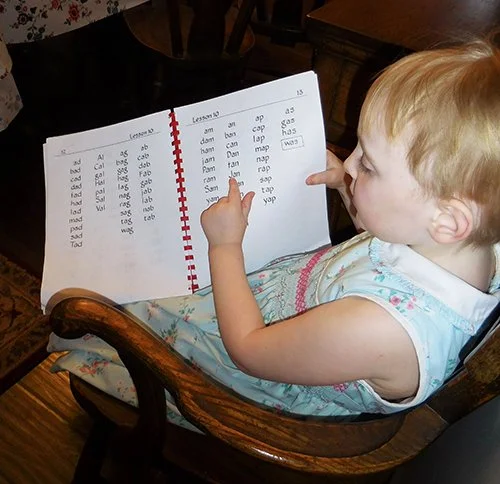
Richeldis with her Alpha-Phonics
DC: Elizabeth teaches Latin, so she knows how to judge material like this. She thought it looked really good and very well organized. Richeldis was old enough to work with the material independently, so Elizabeth said it actually took very little involvement on her part.
AP: Were there any particularly difficult lessons, i.e. some more than others?
DC: Neither Elizabeth nor Richeldis can remember their being any difficulties.
AP: How long did it take for Richeldis to become a fluent reader and how old was she when she began?
DC: Richeldis is a quick learner. It only took her three or four months to begin reading on her own. She was about five years old when she first learned to read.
AP: What was the first book she read on her own?
DC: The “This is Our Family” primer collection.
AP: At what level is she currently reading?
DC: Richeldis is 9 (grade 5), and she reads considerably above her grade level, probably about grade 7. When we visited them last week, she was reading “The Girl Who Lost her Smile” by the English comedic actress Miranda Hart.

Richeldis now!
AP: Do you have any suggestions for other users?
DC: Having lots of attractive books available for children and reading to them regularly, as well as seeing their parents enjoy reading, can create a desire in children to want to read for themselves.
AP: Has she read any of your books yet?
DC: Yes, she has, thank you for asking. She has read my “Choose Your Own Adventure” children’s series as well as a book of autobiographical sketches I did for the family.
Donna is rightfully quite proud of her grandchildren and Alpha-Phonics is quite proud (also rightfully) that we were chosen for at least one of them. We have no doubt whatsoever that her grand kids are also very proud of the world-renowned author who just happens to be their grandma!

Donna and Richeldis
To acquaint yourself with Donna and her work you can visit her at: www.donnafletchercrow.com.

Reading War Champions & How to Teach Reading – Flesch & Blumenfeld

““According to the U.S. Department of Education, 54% of U.S. adults 16-74 years old – about 130 million people – lack proficiency in literacy, reading below the equivalent of a sixth-grade level.” ”
How can we stand still when the minds of our children are being stolen, right in front of our eyes?
Read the quote again.
More than half of our adult population reads BELOW THE EQUIVALENT OF A SIXTH GRADER!!
Uneducated minds are moldable minds.
People become listeners rather than readers.
Information is biased.
Censorship is at an all-time high.
Voices are being silenced.
Add it up!
Be a hero.
Teach a child to read.
How?
The same problem was addressed in the 1950’s when a humble grandfather began a summer project. He decided to teach his grandson (Luke) to read. They started with a list of 72 lessons (which the grandfather later published). The following information is quoted from the foreword of his book, Why Johnny Can’t Read: and what you can do about it, by Rudolf Flesch, 1955.
“Luke learned the sounds of 5 short vowels and 17 simple consonants, and began reading words like jam, nip, wag and hop. The lists went on to cover words with other sounds and spellings and two or more syllables: chipmunk, kangaroo, and snowball. The last list included liberty, independence and blueberries.
Six weeks later, at a Chinese restaurant, Luke read his fortune cookie to his proud family. “Careful planning will bring rich rewards.””
How could Luke learn to read so quickly? His grandfather had used a foolproof method of teaching based on the alphabetic code. With few exceptions, all English words are spelled by this code, which consists of fewer than 200 letters and letter groups, each standing for one or more of the 44 sounds in English. Once a child has learned this code, he can read.”
Samuel Blumenfeld took the work of Rudolf Flesch to heart. He began addressing the illiteracy problem in his own writing. Finally, he consolidated his work into a primer. That text, Alpha-Phonics: A Primer for Beginning Readers, contains 128 lessons. I have used this book to teach reading many times. I have taught my own children and some of my grandchildren, as well as children from the “disabled” population, including a child who was diagnosed with an autism-spectrum disorder and a 12-year-old girl who had been called dyslexic and was not reading. (She learned in about three months). When I finish teaching the 128 lessons, I move to a first chapter book. I remind, as needed, about the sounds contained in words as we read together. For example, I will make statements like, “in this word the ea says e (making the short e sound); or, “in this word the ai says a (making the long a sound).
You can do it too.
So, let me say it again.
Be a hero! Teach a child to read.
There is no time like today.

The Great Phonics Exodus was Followed by Mass Illiteracy

What I learned from Sam, #6
While reading another of Sam Blumenfeld’s books (The New Illiterates: And how to keep your child from becoming one, 1973 and 1988), I came across an intriguing quote. When responding to the high percentage of “functional illiterates” among inmates, Chief Justice Warren said this:
““The percentage of inmates in all institutions who cannot read and write is staggering. The figures on illiteracy alone are enough to make one wish that every sentence imposed could include a provision that would grant release only when the prisoner has learned to read and write.””
Sam documents what happened to American literacy rates when phonics instruction was replaced by look-and-say methods.
For example, do you know that…
During the War in Vietnam there were so few recruits who met the military’s literacy standard that Defense Secretary McNamara was required to change the policy? that recruits with the equivalent of a 6th grade education were allowed in? that McNamara started a pilot program providing reading and writing classes? And that, interestingly enough, the chosen program was phonics instruction?
Or that Dr. Grant Venn, Assistant United States Commissioner for Vocational and Adult Education was quoted as saying, “Illiteracy is really a much greater functional handicap than the loss of limbs.”?
Or that The Congressional Committee on Education and Labor (1969) claimed that “one out of every four students nationwide had significant reading deficiencies,” and that “in large city school systems up to half of the students read below expectation.”?
Or how about the fact that The New York Times (May 20, 1970) reported that “half of the nation’s adults may lack the literacy necessary to master such day-to-day reading matter as driving manuals, newspapers and job applications, according to a study just published at Harvard University.”?

Child with Alpha-Phonics book
And that even the well-loved CBS news anchorman, Walter Cronkite, wrote in Signature Magazine (May 1970), that many who can’t read depend on news broadcasts for staying informed, and that since the TV news gives such an abbreviated version of stories (not nearly what a reader could learn from more complete documents), the nation-itself was in crisis? “The result,” he said, “is a genuine crisis in communication. Since a democracy cannot flourish if its people are not adequately informed on the issues, the problem becomes one of the nation’s survival.”
And the problem continues…
““According to the U.S. Department of Education, 54% of U.S. adults 16-74 years old –about 130 million people – lack proficiency in literacy, reading below the equivalent of a sixth-grade level.””
The solution, says Sam, comes through a return to systematic phonics instruction. This is not to be confused with what Rudolf Flesch (Why Johnny can’t Read, 1955) described as fake phonics.
Systematic phonics teaches the letter sounds, and letter-sound combinations, as they are blended to make whole words. It trains the eyes to move from left-to-right across words and sentences in a process called “tracking”.
This is the method Sam uses in his textbook, Alpha-Phonics: A Primer for Beginning Readers.
Samuel L. Blumenfeld author of “Alpha-Phonics: A Primer for Beginning Readers”
Please follow my blog as I travel through the findings of reading instructors such as Sam Blumenfeld, Rudolf Flesch, myself and others.
Then join the battle for teaching American children to read again.
You’ll be a hero for sure!