

Be a Hero – Teach a Child to Read!
The Alpha-Phonics Blog

Learning to Play Again - Adding Imagination to your Home-schooling

Prior to the electronic invasion of our homes, it was not uncommon to encounter a wide variety of play activities. Building blocks, paper airplanes, trains made from cardboard boxes, paints and crayons, dress-up wardrobes, Fisher Price’s Little People sets and more. I think it’s time to bring these activities back into our homes!
Imagination, creativity, social and emotional development, language and communication skills, thinking, learning and problem solving, and physical development, are among the benefits of pretend play.
Five reasons to encourage pretend play
Source: Therapies for Kids Website
“Pretend play, it seems, is under attack from a fast-paced digital world. Maybe it’s time to start changing that.”
1. To encourage imagination & creativity
Builds a child’s ability for flexibility and then creativity.
How to think for themselves.
Helps children understand another point of view.
2. Supports social & emotional development
As they pretend to be different people or control objects, they are practicing social and emotional roles of life.
They learn how to walk in someone else’s shoes – often mum or dad.
Develop self-esteem and self-awareness.
Learn how to recognize and respond to others feelings when involved in group imaginary activities.
3. Improves language and communication skills
They learn new language that they might not encounter every day.
It’s fun and provides opportunities for discussion.
Gives them control and can help decrease anxiety as language becomes more familiar.
They have to communicate their thoughts to others – an essential social skill.


4. Develops thinking, learning, and problem-solving
By the nature of pretend play, children are presented with problems and scenarios to solve or plan.
How to cope/change when something doesn’t go to plan in a game.
Develop their memory.
Abstract thinking – when an object/person takes on a different meaning.
5. Enhances physical development:
Often physical – e.g. being an aeroplane, climbing ladders as a fire fighter, etc.
Fine motor skills developed while feeding and dressing a doll.
Learning about rough and tumble and limits.


How to encourage pretend play:
Play together face to face so your child can copy your gestures/pretend actions.
Follow your child’s lead – play with things your child is interested in.
Keep it simple – repetition is fun.
Take turns – the play becomes a “conversation.”
Choose the right toys.
Introduce new ideas when they can link ideas together – e.g. if they like to play with cars, take them to the mechanic.
Benefits of pretend play:
Allows you new ways to connect with your child
You can follow their lead and join in with their interests.
Motivating and connecting for all involved.
Helps your child think symbolically.
Develops critical thinking.

Toys for pretend play:
Vehicles (not just for boys!)
Common in children’s lives – so good for simple pretend.
They can put a driver in and go to the mechanic.
Use a shoe box to make a car/bus.
Playdough – In early play, make simple/familiar objects. Later, make food for the tea set, make roads, etc.
Costumes and props – old hats/shoes/scarves/coats. Bags/briefcase/boxes for store/shop, etc.
Favorite stuffed animal or doll – great for feeding and pretending real life situations.
Puppets – moving parts help them come to “life.”
Encourages joint/peer play in older children.
Blocks and Lego – initially might build simple and familiar objects (e.g. house/car). Later might “pretend” that individual blocks are something real (e.g. a bed/food for animals, etc.).
Toy food/dishes/groceries – initially feed the animal, later then a restaurant, have a tea party.

The Savant Who Knew His Mother’s Love (part 3/3)
Continued from The Savant Who Knew his Mother’s Love, part 2
May’s Miracle
Then, in his sixteenth year, something May calls “The Miracle” occurred.
The family had been in bed for hours. About 3:00 a.m. May awoke and thought she heard music. Assuming that Joe had left the television on, she got up to turn it off. But when she walked into the living room, the television was dark and silent. The music was coming from Leslie’s bedroom.

Leslie Lemke at the piano as a boy
She opened the door and saw her son sitting at the piano, playing Tchaikovsky’s Piano Concerto No. 1. The music was Liberace’s theme song, and he had heard it numerous times on television.
Leslie had never played a note of music in his life, but now he was playing like a professional, racing up and down the keys, never missing a note, as if he’d been practicing for years.
May fell down on her knees and cried. And laughed. And cried again. She ran for Joe. They were both on their knees for most of the night, praising God and thanking Him for giving their boy the gift of music. At last, God had given him a talent. And what a wonderful talent!
Playing the Piano, Singing & Finally Talking
The Lemke’s household was filled with new life. Over the following years Leslie’s skill continued to improve. After a while he added singing, and finally he began to talk. He began performing at his home and at weddings. Their world began to expand around the growing recognition of the nearly lifeless boy who began playing piano like a master. Newspapers, television, and magazines spread the story. This patient and loving woman had been given her miracle, and he never missed an opportunity to tell about it.
Leslie Lemke in concert
What had May known? She knew the power of love, and she believed in the faithfulness of God. What did Joe know? He knew the power of teamwork, and he got behind every whim his wife threw his way. He knew to love his wife as Christ loved the church.
Leslie came to be known as a Savant. This word describes a person who is born with very little ability, who then, for reasons which baffle the greatest of scientists, develop a unique brilliance in some specific area. Roughly interpreted, the word savant means one who knows.
What did Leslie know? He knew his mother’s love.

May Lemke in old age at the piano with her son Leslie Lemke
Turning things Around
As May aged, she began suffering from Alzheimer’s disease. During her final days, Leslie returned that love. He continued playing the piano for her, and something new began to happen. The now emotionless and quiet May began coming alive to the sounds of Leslie’s playing, raising her hands to the heavens, and singing hymns with him, like How Great Thou Art and Our Father. She was now the failing one, and Leslie the caregiver.
People Magazine covers the Leslie Lemke story
Love and the Brain
This story is not about reading instruction. Leslie was blind, and May did not know braille. This is a story about teaching — at the Master level. With the faith and willingness of May Lemke, anyone can see positive results.
May’s desire was to bring hope and purpose into her son’s life. This should become our purpose as we teach our loved ones to read. Most of all, we must never forget May’s secret ingredient. Love.
This three-part story was taken from the book Dyslexic No More: Saved by the ABC’s by Meg Rayborn Dawson

The Savant Who Knew His Mother’s Love (part 2/3)
Continued from The Savant Who Knew his Mother’s Love, part 1
Shipped Out to America
Skipping ahead to adulthood, May became engaged to a soldier, following the urging of her mother. He was a man that Maria Hansen had helped during the war. By age eighteen May was an American wife.
Her first marriage had wonderful adventures of its own, and it saw five children into the world. But I will fast-forward this part of her life, through the raising of her family and her eventual widowhood, then to a new marriage, and to the day when she received her final charge. When Leslie came into her life.


Leslie
When May first saw her new son, she remembered that her mother had used slippery elm powder for sick babies. So, she mixed this with milk and a little sugar.
“Try a little, love. You’ll like this,” she said softly. Leslie didn’t seem to understand He lay motionless, his tongue pushing out the nipple. “Suck, baby, you must suck it in.” May encouraged. Still, he lay motionless.
May put her mouth against his cheek, making loud sucking sounds. Then she put the bottle in his mouth, hoping he might catch on. She kept up the procedure most of the afternoon, sucking on the baby’s cheek and putting the bottle in his mouth, over and over again. As the warm milk trickled down his throat, he grew bolder. Pretty soon he was sucking with the zest of a normal, healthy infant. May danced with him around the room. “Baby,” she cried out, “you’re going to live!”

May and Joe Lemke with Leslie
Another natural cure employed by May was for his eye sockets. They were still red and were showing new signs of infection. It was a boric acid solution which she used, until the eye sockets were healed, and the lids lay down naturally. The baby rarely cried or whimpered. He hardly moved. His arms and legs were limp, and when she lifted them, they dropped down. She couldn’t tell when he was awake or asleep
Days, months, and years passed between the smallest indications of any developmental change. After a year she gradually introduced solid food, and eventually moved away from bottles and poured water into his throat, which was the only way to help him drink. Through the years, May refused to listen to suggestions from friends and family. Even her own children encouraged her to put Leslie into an institution. She replied with the same steadfast faith.
“I know God can do things,” May said, “If He can do them for others, then He can do them for me!” But I do think I’ve waited long enough, she thought to herself. She decided to go home and wait a little longer.


May cuddled Leslie in her arms every day, rocking him and singing softly to him. “I want him to know that he’s loved,” she said over and over again to Joe, “to know he has a mother and a father who love him just like other children.”
Despite May’s gentleness, Leslie always tensed, startled, as if he were frightened whenever she picked him up. He never relaxed his body against her like a normal baby. He was more like a plastic baby, rigid, with rarely a cry, never a smile.
But May refused to give up. “Children respond to love, she told Joe. “They can feel it in your body when you hold them close. I know he’ll feel it eventually. It just takes more time with a child like this.”
Until Leslie was seven years old, May always carried him. He was then fifty pounds, and it was evident that she would not be able to continue. She was nearly sixty years old. So, she created an apparatus to strap him to her back and walked with him as he dragged his motionless feet behind. By age nine, when there was not yet a single sign of his attempting to walk, she came up with another idea. Since they lived beside a lake, she encouraged Joe to take him swimming. This became a daily routine. Yet there was still no sign of movement from the child. When Leslie was ten, he took his first step.

A New Prayer
When Leslie was twelve years old, May began to pray a new prayer for her son. She prayed that he might have a gift, something to give his life meaning. Several times a day, she implored, “Dear Lord, the Bible says that you gave each of us a talent. Please help me find the talent in this poor boy who lies there most of the day and does nothing.”
The next major episode in Leslie’s life was the one which led to his worldwide recognition as a pianist. May had noticed him plucking on strings. In May’s eyes, he was making music. This was the talent she had asked for. So she bought him a piano, put it in his room and began playing little songs with him. She helped him listen to records, radio, and television. This became his new routine.
He often sat listening to records or radio for hours, head down, serious, intense, a study in concentration. Sometimes his foot or hand even moved methodically with the beat.
To be continued in Part Three…
This three-part story was taken from the book Dyslexic No More: Saved by the ABC’s by Meg Rayborn Dawson

The Savant who Knew His Mother’s Love (part 1/3)
“Joe and I are different from other people. We just accept things when God puts them before us. It’s like accepting what you have to do in life. Things come at you, and you don’t say, “Am I going to do it?” You say, “Now, how am I going to do it?” ”
Occasionally, we learn of extraordinary teachers. They excel above all others. We can only sit back and marvel at their work. They just seem to know, without any explanation of how or why they know. This is the story of one such teacher, who raised a severely handicapped child. It is told in Shirlee Monty’s book May’s Boy: An Incredible Story of Love. (May shares the copywrite as a joint author.)

Book cover for May’s Boy: An Incredible Story of Love
Leslie was received into the home of Joe and May Lemke at the age of six months. May was told that he wouldn’t live long. He had been born prematurely and weighed only three pounds at birth. He was palsied, and his limbs were limp. His eyes had been removed due to infection, and his parents were unable to care for him.
When May first looked at the child, she was brought to tears. She was 52 years old and had already raised five children of her own. Yet, she accepted the challenge with an unwavering faith which kept her strong through the next four decades with Leslie.
“Oh, Joe, he looks terrible! So forlorn, so long and thin and helpless. But God loves all children, even this little creature. We’ll just see what we can do.”
May’s Childhood Education
May was born in the summer of 1900 in an English fishing village. Her father was a shipbuilder who was often deployed by the royal service, and he was absent for much of her childhood. Her mother was a nurse and midwife with a workable knowledge of herbs and home remedies. She was the mother of ten, yet always generous with her services. She often welcomed beggars and war victims into her home. Her policy was to never turn anyone away because you never know who it’s going to be.
May’s earliest behaviors foreshadowed who she was to become.
May’s prized possession for many years was the rag doll her mother had made for her when she was just two. She carried the doll everywhere, including to meals, where she kept up a constant conversation with her child. “Now, mind your manners. Stay clean and neat whilst you eat!” When one of her brothers accidentally sat on the doll one morning, May spent the rest of the day nursing it back to health.

English fishing village during WWI
May wandered throughout their village visiting new and interesting places, often to be brought home by helpful adults who told about the delightful things she had said and done. Her childhood could have easily been the inspiration of the Eleanor Porter book Pollyanna. Like Pollyanna, she showed love and care to everyone with perpetual and contagious joy. She never missed an opportunity to help or encourage another.
At the untimely death of her 11-year-old brother, she was not yet two years old and stayed next to her mother, from when the injured boy came home, until he died shortly after. Following this tragedy she voluntarily adopted the role as a comforter to her bereaved mother who dubbed her a little ray of gold.

It was the custom for the village children to begin their schooling at age 3 and stay in school until they were 12. Boys were introduced to trades and girls were taught basic homemaking skills, like housekeeping, mending, cooking, cleaning, and needlework. The First World War interrupted May’s youth with new tragedies. She lost 4 brothers and her father, as well as most of her uncles, male cousins, and friends. When supply ships were sunk, food became scarce. It was through her mother’s foresight and planning that she was able to eat.
Before England entered the war, Maria Hansen [May’s mother], anticipating the worst, began to put a bit of strawberry jam in a large stone jar every day. She covered and sealed it with rice paper so it wouldn’t spoil. The children always wondered what it was for.


Later… she lined up May and her three younger sisters and said, “You were always wondering why I did this. I knew things were going to be bad. There’s no food for us now, so this teaspoon of jam will be your meal for today. It will get you by.”
Mrs. Hansen had another method for warding off hunger. She told her children to pick up a fresh piece of tar in the street and to chew on it. She said it would keep their teeth nice and lessen the pain of hunger. So, the children chewed tar, and it helped – some.
May’s Trial by Fire
When May was fourteen, she joined the war effort, working in a munitions building. She assembled bags of TNT and filled shells with explosives. After a year she began transporting sixty-pound shells, pushing a trolley to and from the loading deck where they were then put on trucks.
An atmosphere of melancholy prevailed at the munitions factory, for most of the girls were older than May and had boyfriends or husbands fighting in France. May was always trying to cheer them up by laughing, singing, and dancing. On one of those days when she had everybody laughing and singing, May’s bright little world collapsed.
The girls had finished loading a trolley, and May was starting to push it away. They were singing: “There’s a long, long trail a-winding, into the land of my dreams.” On the word dreams, there was a deafening roar. The trolley blew up, throwing fiery fragments of explosives in every direction.

World War One Memorial
The joyful encourager was thrown thirty feet, rendered unconscious and badly burned. All of her hair was blown off, and her teeth were gone. Her thyroid was damaged which stopped her growth from this point on, at the grand height of four and a half feet. Her face required several surgeries, but it was still scarred. One foot was burned badly and permanently deformed, requiring her to relearn how to walk.
Lessons from the war included both sorrow and pain, still this little Pollyanna transformed the experiences into a loving compassion and an even greater desire to help others. Before long she resumed her training as a nurse-governess, which had been interrupted by the war. She worked under an experienced Nanny where she learned about childbirth and childcare.
To be continued in Part Two…
This three-part story was taken from the book Dyslexic No More: Saved by the ABC’s by Meg Rayborn Dawson

Learning to Read Versus Learning to Love Reading
We found this very interesting and valuable article on the website “Tulsa Kids” and would like to share it with you!
By Dr. Anita Ede, originally posted on TulsaKids.com
Learning how to read is a major accomplishment for a child. Once achieved, a whole new world opens up for children because they can now independently read about topics that interest them. You may picture your child happily reading in a favorite chair and anticipate many visits to the library to check out a book about a favorite hero, mystery or snake. Sadly, this happy scenario may not happen.
The enjoyment of reading does not necessarily follow when children learn how to decode words and comprehend what the words are saying. Scholastic’s 2019 Kids & Family Reading Survey found that the percentage of children who read for pleasure actually drops as they get older. In the study, 57% of 8-year-olds reported reading for fun five to seven days each week compared to only 35% of 9-year-olds. The rapid decline in children who said they actually enjoyed reading is even more disturbing. When 8-year-olds in the same study were asked if they enjoyed reading, 40% answered positively. By the time children turned 9, only 28% had a positive response to the same question. You would think that the 9-year-olds’ greater familiarity with reading skills and comprehension would also increase their enjoyment of reading. So why does literacy not necessarily lead to a love of reading?
Literacy and the enjoyment of reading are two very different things. Literacy refers to the ability to read and write. Developing literacy is an important goal in early childhood classrooms. Oklahoma’s current literacy curriculum is based on the Science of Reading (SoR) and includes teaching phonics, phonemic awareness, vocabulary, fluency and comprehension. Teachers are encouraged to follow a highly scripted, task-oriented curriculum in order to teach each of these skills. So why isn’t all of this literacy instruction leading to a widespread love of reading?

The Special Reading Group & Phonics Cards for Christmas?
In 1955 Rudolf Flesch published his book, “Why Johnny Can’t Read”. He blamed the reading programs of the day. He explained that English is an alphabetic language, and that in order to learn to read efficiently students must learn to “sound out” words rather than merely recognize them at sight. His book included a note to mothers – encouraging them to teach their children to read – and word lists in the back of the book, which they could use to do so.
The book sparked a rebirth of what is known as the reading wars. Educational Journals fought back with many articles in defense of the new methods and harsh criticisms of phonics.
Anna Gillingham, a reading teacher/psychologist of the day, (known for her affiliation with the renowned reading scientist Samuel T. Orton) responded to journal debates with a letter to the editor in the 1958 edition of Elementary Education.
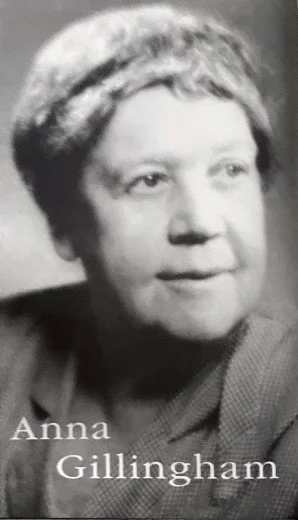
Anna Gillingham
Here is an excerpt from that letter. It describes an unexpected response from general education students – when they saw how the at-risk students were being taught to read. It had become evident to them that the phonics-first approach to teaching reading was more successful than the whole-word approach – which was being used in the regular classrooms.
To the Editor —
“… Twenty years ago as a pioneer, I was experimenting with the selection of kindergarten children who would probably have trouble with reading, unless taught by the technique already found successful with older remedial pupils. I shared the anxiety of many teachers and parents, that being set apart in a special group would cast a stigma upon its members. However, by the time the experiment had been tried for two or three years, we found our fears groundless.”
General Education Students Asked to Join Remedial Group
“Instead of resenting the placing of their children in a separate group, mothers came and asked for the privilege of having their children taught as a cousin or neighbor had been taught last year, “because he learned so much better.”
“Instead of looking with scorn or ridicule upon their classmates sent out for this special kind of reading, the class manifested envy as of a privileged group. Children asked, “Miss Blank, am I going on this same way with you next year? It’s a lot nicer than what the other children are having.” By the time the project was in its third year, the rest of the class began to recognize the advantage the special group was experiencing. A third grade boy said, ‘kids learn a great deal that we don’t know. We know a lot of words, but when we don’t know a word we have to ask, but they can work it out for themselves.'”
““Another third-grade boy who had always read fluently in the SightWord reading group, asked his teacher wistfully, ‘If I read this very well, may I go with Miss Blank’s class? Those children in that special group know so much more.’””

Reading class in a one-room schoolhouse
“Children asked their mothers, and mothers asked us, what could be done so that all might receive the privileges of the Special Group.
A fifth grade girl, who was an excellent speller, was excused from the class with two other children to work on a delightful art project. Meanwhile, her entire class was having spelling by the Gillingham Technique. Technique. After a few days she went to the teacher with the request, “I can do this painting at home.”
““‘Mayn’t I please be in the class for spelling? It is so much fun to learn the rules and the history of words and all the rest that we have been doing. It is so much nicer to know the reason than just to remember the spelling of words and not be sure that we are remembering them correctly or why they are that way.’””
Wanting to Practice Drills
“Numerous similar expressions could be quoted from all the schools in which the experiment has been tried. Pity was felt by some teachers for the children of the Special Group who must go over and over the dull [phonics] Drill Cards.”
“To the astonishment of these critics, however, there were protests by the children if, for any reason, the Cards were omitted on a particular day. To the genuine surprise of the teachers, parents not infrequently asked to buy the Cards because the child wished them for Christmas or birthday, or, ‘so that I can teach my cousin, because in his school they don’t have them. He doesn’t know the sounds!’

Rudolf Flesch, Lesson 1 from “Teaching Johnny to Read”
“Those teachers learned a lesson greatly needed in many other fields, namely, that it is the teacher and not the pupil who is bored by drill and repetition. The child feels delight in definite progress in which he can see tangible evidence of success. ‘See me gain, see me gain!’ exulted one child.
“Recently I had the privilege of observing a second grade selected group being taught by the Alphabet Approach. They had been clamoring for a new diphthong Card for which the teacher had declared them not yet ready. On this day she announced that they might have it. ‘And it is a tough one!’ she warned. Hands were noiselessly clapped and several youngsters joggled up and down in their seats. ‘May I try it, may I try it?'”
[Yes, you read that correctly. Anna Gillingham’s “special group” became the preferred group. The students themselves saw the benefits of being in the remedial group. One of the boys discovered that when he wanted to know a word, he needed to ask. When the others wanted to know a word, they were able to figure it out themselves. This is because they had learned how to read by the alphabetic method, as Anna Gillingham called it. In her editorial she goes on to explain what she means by phonics and she tells how the meaning of the word phonics, within the process of teaching with the whole word method, had changed.]
Misusing the Word Phonics
“Another point which should be made clear in the mind of any teacher attempting to use my technique is the distinction between this approach and what is usually accepted as ‘phonics.’
“Teachers not infrequently tell me that they are using my method, that they “always did believe in phonics.” They usually mean “analytical” or “functional” phonics. By this method several words are taught from one of the delightful primers that have been carefully constructed to introduce the same word in a good many situations [whole-word primers]. After a considerable number of words (perhaps one hundred) are recognized on sight, they are gradually broken down into their phonetic units. In the hands of a skilled teacher this, the current method, attains apparently satisfactory results with many pupils. Others fail because they cannot learn the preparatory group of sight words. Whether or not this method is desirable is a matter of opinion. The positive statement to be made here is that this method of teaching phonics is not to be confused with the Gillingham Technique [Alphabetic Approach].”
The Sight-Word Method vs the Alphabetic Approach
“The Sight-Word Method and the Alphabetic Approach are based upon two distinct and mutually exclusive concepts. When men first began to attempt to communicate with each other at a distance by written messages, they drew pictures. Their communications were, in fact, pictorial narratives. Gradually these pictures became conventionalized into characters bearing less and less resemblance to objects. Thus we find Chinese characters and Egyptian hieroglyphics, each standing for a word or even for a phrase or short sentence. There are many words in any language and a scholar who had many ideas to communicate had to learn many thousands of ideograms – a laborious task.”
Using Letters to Represent Sounds
“About three thousand years ago it dawned upon some genius or group of geniuses in the Eastern Mediterranean region that it would be easier to have a character (letter) stand for a speechsound. Then these letters, few in number (English has 26), could be combined and recombined thousands of times to form words. As long as a language developed by itself, it was perfectly phonetic. It was only when two languages mixed through conquest or migration that there came to be silent letters or more than one sound for a letter, or more than one letter for a sound. This general approach to written language prevailed in Europe and in America until something less than one hundred years ago. It is upon this concept of combining letters to form words that the Gillingham Technique is based.”
““Flesch explained that in the early 1930s, the professors of education changed theway reading was taught in American schools. They threw out the alphabetic phonicsmethod, which is the proper way to teach anyone to read an alphabetic writing system,and they put in a new whole-word, look-say, or sight method that taught children toread English as if it were Chinese, an ideographic writing system. Flesch explainedthat when you impose an ideographic teaching method on an alphabetic writingsystem, you get reading disability.””

Samuel Blumenfeld
Author of “Is Public Education Necessary”
“N.E.A. Trojan Horse of American Education”
“Alpha-Phonics”
Gillingham Editorial (continued):
Returning to Ideographs
“Late in the 19th Century there came a return to the ancient ideogrammatic concept. A word was to be learned in its totality as an ideogram, disregarding the letters of which it was composed. In the extreme form of this method the letters are not learned at all. This Sight-Word Approach swept over America and has worked havoc: with reading and spelling. Several of my older Remedial Reading pupils have told me gravely that until they had learned my Drill Cards, they had no idea that the letters in a word had anything to do with its pronunciation! Here we have a clear demonstration of the mutual exclusiveness of the two concepts.

“A pupil who is trying to remember a certain word as an ideogram cannot at the same time be sounding the letters in series to work out the pronunciation of the word. He may remember the wrong word, just as I may confuse the names of Mrs. Jones and Mrs. Smith met at a tea. Such a pupil may say garden for basket (both words having been previously encountered in the same story), or bird for robin (words seen as labels to pictures).
“The value of introducing phonics while the child is being exhorted to remember words as sight units is controversial, but such an introduction of the sounds of the letters as an aid to learning words as ideograms must not be confused with the Alphabetic Approach.
“And now we come to my last point. It seems to me important that teachers interested in my technique should be made familiar with trends in the widening application of the Alphabetic Approach.”
Why not just teach words as ideograms?
“At least a dozen years ago teachers began to inquire, ‘Since this Alphabetic Approach is the means of saving from failure those who would otherwise have failed, or is the best Remedial Technique for those who have already experienced the frustration of failure, why would it not be the best way to teach all children?’ For some time my voice gravely joined the chorus of conventional answers. ‘If a child can learn to recognize ideograms (Sight-Word Method), he should have the privilege of learning this way. The Alphabetic Approach would slow down his potential speed.'”
“But as the years went by I wondered more and more. This was not a flippant question. It was asked by some of our best and most experienced teachers. For example, Mary Davidson, former head of the Primary Department of the Fieldston Lower School in New York, asked it with purposeful interest, and is now using the Alphabetic Approach with whole classes in the Oakwood School in North Hollywood, California.


“More and more emphatically it was forced upon my attention that there is no sharp line between the potential reading failure and the child who learns with a slight degree of success. If the Alphabetic Approach is necessary for Jimmie, why is it not good for Harry whose test results show only a slight difference? With the almost universal uproar about poor spelling, we can afford to give some training in the kinesthetic and auditory aspects of the language pattern at the beginning. Only a few supernormal children never misspell. These are too few in number to have a school policy made for them. Experience proves more and more that the Alphabetic Approach is slower for only the first weeks or very few months. After that, the progress of children thus taught is often more rapid than that of their Sight-Word Method classmates. Since there is no sharp line between the children supposed to need the Alphabetic Approach and those for whom the Sight-Word Method is preferable, it begins to appear that the Alphabetic Approach may eventually come to be regarded as best for all…”
Signed — Anna Gillingham
This editorial was reprinted in Samuel Blumenfeld’s book, The New Illiterates and How to Keep your Child from Becoming One. This book was recently reprinted by Paradigm Books and is available on Amazon, along with Blumenfeld’s primer: Alpha-Phonics: A Primer for Beginning Readers.
Samuel Blumenfeld uses the alphabetic method as it is described by Anna Gillingham. The Blumenfeld primer provides word lists which introduce the sounds of the letters and combine them systematically into words. The lists replace the drill cards which Anna Gillingham mentions in her editorial.
Edited by Meg Rayborn Dawson (homeschooling mom of 9) author of: Dyslexic No More: Saved by the ABC’s

Teaching a Baby to Play Pat-a-Cake
Developing Skills Through Play
“Pat-a-cake, pat-a-cake, baker’s man, Bake me a cake, as fast as you can; Pat it, prick it, and mark it with B, Put it in the oven for baby and me.”
Here is a great video showing a mom interacting with her baby using the rhyme Pat-a-Cake.
Why not try this with your child? I like doing this babies sitting in my lap as I direct their hands through the gestures. Older children will be able to clap their hands as you hold them. Watch the video and try it yourself!
Here are some good reasons for playing Pat-a-Cake:
When you interact with children through hands on poetry games like pat-a-cake, you help them develop:
Attention skills
Listening skills,
Pre-reading skills…
Communication skills
Phonemic awareness skills
Coordination skills
Relationship skills
…and on and on. You name it. Enjoy!

Illuminating the Brain and Watching it Read
“Up to the year 1870 there was no physiology of the [brain] hemispheres. They seemed to be out of reach of the physiologist. In that year the common physiological methods of stimulation and extirpation were first applied to them.”
So, what exactly is “stimulation and extirpation”, and how was it used to learn about the physiology of the brain? The concept is basic. When parts of the exposed brain (usually belonging to a dog) were stimulated, then certain groups of muscles would contract. When those same areas of the brain were cut out (extirpated), then the same muscles would no longer function.
Then it was found, by the same method, that some areas of the brain were not linked to muscles. When these areas were cut out, other functions were lost, like with the retina of the eye, or the sensory nerve-endings in the skin.
““Searching investigations have been made, and still are being made, by numerous workers on this question of localization of function in the [brain]. Our knowledge has been increased in precision and filled out in detail, especially as regards the motor area, and has even found useful application in medicine.””
The exploration of the brain is quite intriguing, and useful. Thankfully, our techniques have moved beyond stimulation and extirpation. Today, with the use of functional Magnetic Resonance Imaging (fMRI), our knowledge is exploding rapidly. Discoveries about the architecture of the brain and the mapping of circuitry connecting various parts of the brain which work together, are beyond fascinating. A leader in this area of research is the French neuroscientist Stanislas Dehaene. He has studied the brain’s reading circuits, and he explains the process in his book, Reading in the Brain.
The Brain’s Reading Circuit

“For more than twenty years, functional brain imaging techniques have revolutionized the study of the human brain by literally allowing us to ‘read in the brain.’ Their enormous potential lies in their capacity to visualize brain activity directly, at the very moment when a human volunteer performs a mental operation like reading.”
Through the use of MRI scanners, Dehaene discovered which areas of the brain are activated as readers and non-readers read. His studies have verified the findings of those early eye surgeons and their study of autopsies. His pioneering advances in the science of how we learn have inspired many other research projects around the world, and it is through this relatively new realm of science that we are finally able to see and understand how our brains read. Scientists are now even able to explain the differences between reading instruction methods, and their competitive advantages from the brain’s point of view. This new knowledge is being used to train reading teachers.
Dehaene describes the brain’s ability to read, something like this: When the alphabet was invented, it became necessary to teach our brains to read. Like any new skill, we had to carve out pathways through related brain areas, apply new information, and practice what we were learning.
In other words, we were given the alphabet, and in order to read, we needed to first learn how this new tool worked. Those who learned how to use the alphabet taught others, like seasoned mechanics teaching how an engine works, from under the hood of the car. This handing down of knowledge has traveled through time to the present day. Finally, the process of learning to read is being seen and studied in technological laboratory settings.
Interestingly, the area of the brain which was found to be lesioned in Hinshelwood’s patients with acquired word-blindness (the left angular gyrus), is now seen as a part of a complex reading network. Dehaene has identified the brain regions which are involved in the reading process and describes how they are interconnected. (I recommend googling his lectures online.) The process of reading travels through the brain as though it were on an assembly line.
In a layman’s rough analysis of this process, there are pathways leading to areas where the brain analyzes pronunciation and articulation, there are roads to brain dictionaries which discern and record meanings, there are routes to storage facilities. As the reader learns, the connections between these designated, specialized, brain areas become stronger. Circuits are formed as the brain connects the paths. When information travels across these circuits, the pathways are strengthened.
The same fMRI technology has also shown that the brain regions which are activated during the reading process, are also activated very early-on when babies listen to spoken words, even before birth. These findings support the encouragement of parents in reading to and talking with their children, the earlier the better.
Reading development is supported by the process of becoming aware of spoken sounds, of hearing and manipulating them in the brain, before letters have been introduced, and even before uttering a word. Early activity in this brain region fosters a faster grasp of the phonics code. The amount of time the child spends listening to spoken language corresponds with the speed of future decoding. For this reason, scientists are recommending the teaching of phonemic awareness as a prerequisite to phonics reading instruction.
Dehaene Explains More about How we Learn
Dehaene has gone further into his understanding of how we learn, and how to create the best environments, attitudes, and behaviors for learning. In his book How We Learn: The New Science of Education and the Brain (2020), he summarizes his findings in a list of recommendations for optimizing the effects of teaching. Hopefully, these ideas along with new knowledge he has presented about how the reading brain works, will begin to make their way into classrooms around the world.
For example, Dr. Dehaene tells us not to underestimate children, and to recognize and exploit the huge learning potential of a newborn brain. He explains the importance of tactics such as a rich learning environment for the child, recommending the use of games, storytelling, and puzzles, answering their questions, and using a rich vocabulary with clear pronunciations when speaking to them. Dehaene also describes attention, which he calls the “gateway to learning”.
Teachers should become masters at capturing their students’ attention and directing it to what matters. This implies carefully getting rid of any source of distraction: overly illustrated textbooks and excessively decorated classrooms only distract children from their primary task and prevent them from concentrating.
Dehaene also highlights the importance of encouraging and challenging learners, as well as setting clear learning objectives. Practice (repetition) is extremely important and, surprisingly, so is sleep.
Sleep is an essential ingredient of our learning algorithm. Our brain benefits each time we sleep, even when we nap. So, let us make sure that our children sleep long and deep. To get the most out of our brain’s unconscious night work, studying a lesson or rereading a problem just before falling asleep can be a nifty trick. And because adolescents’ sleep cycle is shifted, let’s not wake them up too early.
Dehaene also breaks the process of learning into four pillars. These, stated briefly, are:
Attention, which amplifies the information we focus on.
Active Engagement, an algorithm also called “curiosity,” which encourages our brain to ceaselessly test new hypotheses.
Error feedback, which compares our predictions with reality and corrects our models of the world.
Consolidation, which renders what we have learned fully automated and involves sleep as a key component.
Attention, Active Engagement, Error Feedback & Consolidation
Science-informed teaching is only half of the equation. Let’s consider the other side. If laboratory scientists can inform field workers, how about tutor-informed scientific research? Arguments have been waged throughout the last century in a conflict which has been called “The Reading Wars”. These conflicts have been, largely, between field scientists (tutors) and statistical examiners (university research teams). Let me explain.
Field science might be best seen through the experiences and work of individuals such as Jane Goodall. This branch of science is sometimes called naturalistic observation. Goodall spent decades in the field, studying how chimpanzees live (attention). The field became her laboratory and her observations led her to create, test and evaluate ever expanding hypotheses (active engagement). Watching similar behaviors, repeatedly, became her scientific method. Simply stated, she learned by watching and interacting with the animals, testing hypotheses as they struck her, and remembering and recording those observations, to be re-examined in similar field experiences.

Babies become field scientists in their own sort of way, as they begin to explore more and more deeply into their ever growing environments (attention), as they move from rolling to crawling to walking (active engagement). They test their own hypotheses in their own little brains asking questions like, “What happens when I push this button?”, then after pushing that button, they observe the results (error feedback). Babies are forever collecting data and recording it in their memories. And as they sleep, the lessons they learned throughout the day’s explorations are reviewed and organized in their minds as they sleep (consolidation).
Another example of a field scientist is the reading or math tutor. Imagine these dedicated individuals who show up at homes, in classrooms, or even invite struggling learners to their own homes. As they teach, they observe, experiment, and evaluate outcomes, while collecting their own sort of data. In other words, they observe learners, recognize problems, and try interventions, which they then accept or reject as they receive error feedback. This data is rarely stored in laboratories, to be compared with similar data. There is seldom time to even record it. As soon as one student leaves, another arrives. Yet, information gained during tutoring sessions is consolidated in the brains of tutors, where it is stored away to be used with other students who bring similar problems.

Although the tutor’s ever-increasing knowledge may not be recorded, it is still preserved. Students often become tutors, teaching in ways which they have been successfully taught, and the data banks are passed from brain to brain. Yet, the data rarely arrives on paper or in medical journals.
In an ever demanding scientific world this unpublished data, is rarely considered credible. There is no scientific peer review. That is, unless you observe the delight of previously troubled parents and caregivers, as the anxiously watch and wait for the outcomes of tutoring sessions. And the delight they express when their previously struggling loved ones finally catch on to reading or math, thus proving wrong the warnings of nay-sayers who had little confidence in the ability of those children to learn. Unfortunately, those types of data are usually dismissed as anecdotal, which is not always honored in scientific circles.
Field-Informed Science?
What would happen if neuroscientists were to leave their laboratories and visit the field, where they could observe working tutors as they apply individualized, field tested interventions? Could the interventions be taken from the field into the laboratory, and be tested with fMRI technology?
For example, the stories of Dr. and Mrs. Samuel Orton have been preserved in university archives. The previously mentioned 3200 case studies are available for examination. Various reading instruction methodologies have been explored and recorded there. Interventions have been applied, observed, and evaluated in these studies.
Let’s consider the multisensory approaches to teaching which have been put forth through the work of the Ortons. Why and how do they work? What changes can be seen in brain scans when additional senses become involved during reading instruction. It may be difficult to observe the impact of movement within the confines of a sensitive MRI machine. Yet it is not difficult to suppose that creative researchers may ultimately find ways to help the MRI technology to adapt to the performance of a wider range of examinations.
Here’s an example. Suppose that a reading tutor stumbles across some unexpected intervention. Maybe he notices that when classical music is played in the background, while he is teaching reading, it seems to have a positive impact on some students. Or perhaps other students become successful at improving their fluency when they read along with rap music. Can we take these interventions into the lab? Can we look into the brains of these students as they light up in various regions and make connections to other parts of the brain. Will we observe the involvement of additional brain regions? Imagine the possibilities that wait to be discovered, if the discoveries of tutors can be examined by the neuroscientists in their MRI scanners.
The Impact of Emotion & Stress Upon the Brain & Learning
I’d like to send out one more idea before I leave this topic. I previously discussed the conglomeration of emotional disturbances which seem to wrap themselves around reading challenges. I gave examples of students who began with optimism and ended in despair.
I’ve shared discussions about nurture versus nature, asking whether the poor emotional health and lack of attention is a cause or an effect of the experiences of struggling readers. Is it possible that the cause and the effect take turns, creating a vicious circle, and suggesting that the child begins in optimism, discovers his inadequacy, sometimes through bullying-types of experiences during learning, and then begins to question himself? Does he then adjust his behavior, in an effort to self-protect against this hard-to-understand enemy of learning, and fight back? Or develop a silent repertoire of cheating and deception?
I also mentioned comments made by Dr. Samuel Orton and his wife, stating that attention problems are often overcome at the point when the reading ability establishes itself. Are there actually types of reading instruction and specific interventions which teach the student to expand his attention span? What about the importance of practice? What happens in the brain when training is repetitive? Do neuro-networks become stronger? Or what is the value of encouragement? How great of an impact might it have? Are there scientific methods for a deeper view of the brain? Can we see an increase of myelin through repetition?
Can ideas like these be hypothesized and tested by data crunching scientists? Can the impact of stress be seen in the brain? Hinshelwood acknowledged backward progress when a student was sick or tired. Can this be understood through scientific lenses?
In my own optimistic mind, the options are endless, and as we discover these mysterious links between learning and emotion, we will embark on the pronouncement of a new urgency, teaching educators not only what becomes known about the learning brain, but also about the power of positive reinforcement and how to avoid the devastating effects of excessive, punishing behaviors towards our students. Parents, teachers, and caregivers will learn to encourage rather than condemn.
The future holds the possibility of discovering much more knowledge than we can even imagine. The impact of scientific study, as it informs reading, is only the beginning. Imagine the possible expansion of variables waiting to be discovered in the field and then transported to the labs for their examination through this amazing new technology of scanning working brains. We have reached the day where we are now becoming informed by the brain itself. There is so much to look forward to!