

Be a Hero – Teach a Child to Read!
The Alpha-Phonics Blog

Deaf Mother Teaches all her Children to Read with Alpha-Phonics!
Testimonial
““I know you have many people tell you that your program does work, but how many DEAF parents have told you?””
Six years ago, my older daughter Chayah was taught using your Alpha-Phonics book and she learned to read at age 4. Today she collects books such as John Grisham’s novels (her best liked books), Nancy Drew; The Boxcar Children, Smithsonian magazines, and she read almost the entire library in my living room. There were times I didn’t think some books would interest her but she read from first page to last page in every book. Even rereading them. She reads books like The Complete Book of Food and Nutrition by J.I. Rodale (I always thought these books were for adults but she proved me wrong). This week she is reading “The Beautiful Mind” The Life of Mathematical Genius and Nobel Laureate John Nash.
My five year old son, Ru, just read the entire book “The Fire Truck” to a neighbor who didn’t really think he knows all the words. She demanded to know what kind of program I use to teach them. She is spreading the word.
I wanted you to know that your program does really work and I have been trying to convince many friends and relatives that it was a mistake for them to use other programs to teach their children how to read. All of them were impressed by our children’s (ages 10, 5 and 2- the two year old is recognizing the sound symbols) ability to read.
I know you have many people tell you that your program does work but how many DEAF parents have told you that even a deaf parent who teaches children with your program does work. I am the proof because all my three children read. I recently registered my ten year old daughter in Eula public school. They knew I home-school all my children. They were surprised that my daughter has the highest reading comprehension score than anyone in their fifth and sixth grade classes. I put my daughter in public school because she wants to experience the school system and have P.E., Music, and interaction with other students for two years.
Sincerely,
Cheri Walters


A Phonics Comeback in Ohio
Literacy reforms coming to Ohio classrooms.
By Aaron Churchill, originally posted in the Akron Beacon-Journal
“It appears that another knowledgeable individual is waving the banner for phonics in Ohio.”
Significant changes in reading curriculum and instruction are coming to Ohio elementary schools — and they couldn’t come soon enough.
For decades, ineffective methods have plagued classrooms, leaving too many students struggling to read. A recent survey from the Ohio Department of Education and Workforce found that two of the most popular curricula statewide are Irene Fountas and Gay Su Pinnell’s Classroom and Lucy Calkins’ Units of Study. Districts large and small — rural, suburban, and urban — have bought and installed these reading programs in their schools. Yet both are notorious for promoting the harmful practice of three-cueing, a technique that prompts children to guess at words based on pictures or other “cues,” instead of sounding out letters to recognize words (i.e., phonics). Empirical research has clearly demonstrated the vast superiority (our emphasis) of phonics over cueing techniques.
Well, to tens of thousands of successful Alpha-Phonics learners, this is not news!

Women Shouldered Most of Kids’ In-home Schooling Needs During Early Pandemic
By Laurel White, orginally posted on the University of Wisconsin-Madison blog
We don’t think this comes as much of a surprise…
Women took on more education-related childcare responsibilities than men during the first several months of the COVID-19 pandemic, and this disparity was even sharper for some lower-income women, according to a new University of Wisconsin–Madison study.
The study, published in the journal Sociology, found that daily time spent helping children with education-related activities, such as virtual schooling, homework and school projects, decreased for men in 2020 compared to previous years. For women, that daily time commitment more than doubled. For low-income women living in areas with widespread childcare facility closures during the pandemic, the increase in time was even steeper.
The study used 2020 data from the U.S. Database of Child Care Closures, a public database created by researchers at Columbia University, along with several years of daily time use data from the U.S. Bureau of Labor Statistics’ American Time Use Survey.
These first three paragraphs are probably the most valuable. After these the author argues for more government aid and intervention, which you may or may not agree with. We, of course, happen to know many mothers who taught their kids to read during this time and/or took over the schooling of their kids completely. So, all in all, the turn towards homeschooling was and has been largely driven by moms who could not stand by and watch their kids fall behind. And they also soon realized that using phonics to teach their kids to read is the basis for all learning to follow.

The Science of Reading – Why we Should Read to our Children
Build Vocabularies: Words are for Thinking!
When you have an idea, do you have enough words to express it?
If you need a new word, where do you find it?
If you answered that you “just know it from memory,” then how did it get into your brain’s word memory bank?
The truth is, words need to be taught. During the earliest years of life, children are listening and learning, even before they are born. They are being taught by environmental sources of language – people, news channels, game videos – or from wherever words are being spoken. The more words children hear, the more words they will ultimately use when reading, speaking and writing. The type of words children learn will affect the audiences they will be able to address without criticism.
Children who sit quietly and listen during adult conversations will benefit by gaining specialized vocabularies related to the particular interests of those adults. Children who sit alone, listening to electronic devices, will be impacted in either positive or negative ways depending on what they are listening to.
This information, alone, should cause us to care about what words our children are exposed to. What are they hearing? What are they learning? What will they be saying?
Neuroscience Guides Vocabulary Acquisition and Usage

According to the French neuroscientist Stanislas Dehaene, reading bedtime stories to children, beginning from toddlerhood and continued through their growing-up years, strengthens their brain circuits for language and helps them learn to understand texts and formulate complex thoughts.
(Dehaene has spent several years studying the results of fMRI scans and has reported back to the world at large about how the brain reads. His discoveries have changed how we think about the child’s acquisition of language and how it impacts the ability to read. Dehaene also recommends reading to the child in the womb. According to Dehaene babies are born with a preference for listening to their native language which he says implies that language learning starts in the womb.)
Cultural Activities and Traditions
Fingerplay, Nursery Rhymes and Children’s songs are often passed down through families from grandparents, aunts and uncles, and other loved ones.
Some children’s songs have dances that go with them. When movement is added to the human interaction, the benefit of multisensory activities on the brain is added to the mix.

Research from the University of Melborne
A group of scientists (University of Melborne: Department of Education and Early Childhood Development) have recently reported what they learned when examining the impact of a person’s early exposure to words. I recommend reading this report, but for now here are two key facts from their findings, published online at: Reading to Young Children: A Head-Start in Life
A Direct Effect on School Outcomes:
“The frequency of reading to children at a young age has a direct causal effect on their schooling outcomes regardless of their family background and home environment.”
Higher Achievement Scores:
“Children read to more frequently at age 4-5 achieve higher scores on the National Assessment Program – Literacy and Numeracy (NAPLAN) tests for both Reading and Numeracy in Year 3 (age 8 to 9)
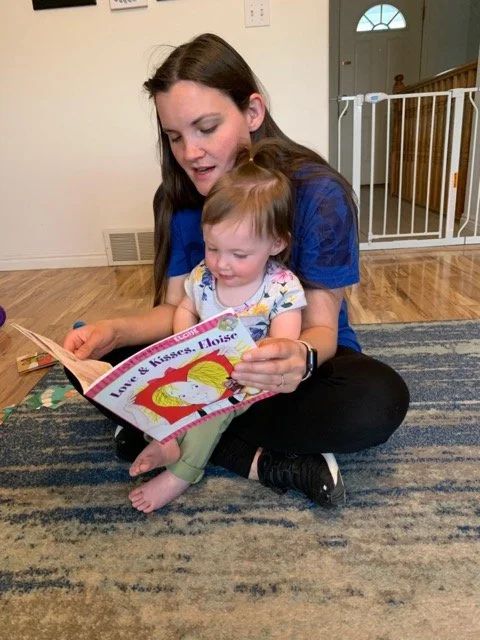
Child listening to her mom read
Impacting Young Minds is in Our Hands
The science references in this short blog should be enough to convince us of how great an influence we have when we interact with children. Even if we don’t have children of our own we can wield that influence by volunteering in our communities. New readers are always in need of someone they can read to. We can be those someones. Volunteer!
If you don’t read with the children of our community, who will?

Renowned Author Recommends Alpha-Phonics – Donna Fletcher Crow Interview
Donna Fletcher Crow
“Alpha-Phonics is honored and proud to list among its friends the well-known author Donna Fletcher Crow. Mrs. Crow’s impressive bibliography lists more than 50 books, mostly mysteries and historical fiction and most of those taking place in England. Her most recent, Glastonbury, is a tale of the Holy Grail and may prove to be her most popular ever. Recently we were able to discuss with her the role Alpha-Phonics played in teaching one of her grandchildren, Richeldis, how to read.”
Interview:
Alpha-Phonics: Donna, how did you first become acquainted with A-P?
Donna Crow: In visiting with June and Peter Watt about the books they published and the value of children learning to read well at an early age. I was especially interested for my grandchildren.
AP: How did Elizabeth, Richeldis’ mother, learn about Alpha-Phonics?DC: I told our daughter Elizabeth about Alpha-Phonics when Richeldis was at a learning-to-read age.
AP: How easy or difficult did Elizabeth find it to use?
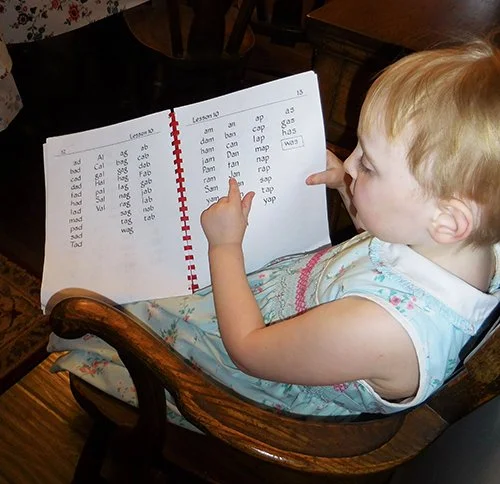
Richeldis with her Alpha-Phonics
DC: Elizabeth teaches Latin, so she knows how to judge material like this. She thought it looked really good and very well organized. Richeldis was old enough to work with the material independently, so Elizabeth said it actually took very little involvement on her part.
AP: Were there any particularly difficult lessons, i.e. some more than others?
DC: Neither Elizabeth nor Richeldis can remember their being any difficulties.
AP: How long did it take for Richeldis to become a fluent reader and how old was she when she began?
DC: Richeldis is a quick learner. It only took her three or four months to begin reading on her own. She was about five years old when she first learned to read.
AP: What was the first book she read on her own?
DC: The “This is Our Family” primer collection.
AP: At what level is she currently reading?
DC: Richeldis is 9 (grade 5), and she reads considerably above her grade level, probably about grade 7. When we visited them last week, she was reading “The Girl Who Lost her Smile” by the English comedic actress Miranda Hart.

Richeldis now!
AP: Do you have any suggestions for other users?
DC: Having lots of attractive books available for children and reading to them regularly, as well as seeing their parents enjoy reading, can create a desire in children to want to read for themselves.
AP: Has she read any of your books yet?
DC: Yes, she has, thank you for asking. She has read my “Choose Your Own Adventure” children’s series as well as a book of autobiographical sketches I did for the family.
Donna is rightfully quite proud of her grandchildren and Alpha-Phonics is quite proud (also rightfully) that we were chosen for at least one of them. We have no doubt whatsoever that her grand kids are also very proud of the world-renowned author who just happens to be their grandma!

Donna and Richeldis
To acquaint yourself with Donna and her work you can visit her at: www.donnafletchercrow.com.

The Grandmother Who Taught Three Generations to Read
This is the testimony of a classically-trained Grandmother who recommends Alpha-Phonics for teaching reading.
(from Mary Beck Rutkowski, September 2021)
I was blessed to hear this grandmother’s story. She granted me the privilege of sharing her memories here, which I’m sure you will enjoy as much as I do.
““The public schools here were much more advanced into the weakness and failed methods of teaching- so it seemed we were in ‘reverse’ gear, so to speak.””
Laying the Background
“I attended Catholic Parochial school on Long Island, NY, where I was born. Excellent education and though I’d never heard it called as being the ‘classical’ method, it was exactly that.
“Memorization in every subject -rules of grammar, parts of speech, diagramming sentences, — Multiplication tables, addition and subtraction, factors, decimals, percentages, ratio and proportion, square root… History – names of countries, their general history – boundaries, wars, and causes. Geography – oceans, rivers, lakes, mountain ranges…. On and on. As in the Classical trivium, memorization was key.

Mary Rutkowski’s old high school
“After grammar school, I attended a Catholic high school. Sadly, it was not anything like I had expected. Nothing like the follow-up to the first level of the Classical method. I took 2 years of Latin, a year of French and did very well in both. English, even in grammar school, was my favorite and best class – I received the graduation award in English. Competed in spoken French in a NY state-wide competition and scored 6th. Won speech competitions. All this is to lay the background of how, where I was educated to further define what my interests were and where I was at my happiest and my best.”

Mary Beck Rutkowski
Moving Forward
“Please, I will believe you do not take it as bragging. My first child, a daughter, attended our local public school – circa 1967. At that time, the public schools were fairly ‘ok’ and she had a superb Kindergarten teacher, a marvelous lady, ‘Old School’ in every way. She then went on to first grade, another fine teacher. Our son followed 3 years later and did well.
“In 1968, we moved from Long Island to northern Idaho, and that is where we have lived since. The public schools here were much more advanced into the weakness and failed methods of teaching – so it seemed we were in ‘reverse’ gear, so to speak.”
Avoiding the Pitfalls of Public Education
“There was some talk of bringing in ‘sex education’ !!! The other pitfalls and errors of ‘Public’ (Government) schooling became increasingly apparent to me, and we finally put them in Christian school. (As many of us know, this choice does not always meet expectations, but it was the best choice available then.) About this time was when I began to hear of Home Schooling. I did a little of this with my children but did a lot more with my Grand Children and even more with my Great Grand Children.”
Meeting Sam Blumenfeld and His Work
“Somewhere during these years, I heard of Mr. Samuel Blumenfeld !!! I read his book, – “NEA – Trojan Horse in American Education” That was such an eye-opener and I went on and read many more of Mr. B’s books and whatever was available then. He came through Spokane WA on a speaking tour and of course, it was beyond superb.

“It was customary that the host state would take the guest speaker out for dinner – we did and somehow, it was my good fortune to share a small table with Mr. B. He talked about the proper way to teach Reading, Phonics and I ordered his teaching materials – “Alpha-Phonics”.
From Alpha-Phonics to the 6th year McGuffey Reader
“I have used phonics over the years with children, Grands and Great Grands… have taught my Great Grandson to read just over the last year or so. He now reads everything he sees and can read from the 6th year McGuffey Reader. I gave away my original copy of Alpha Phonics to one granddaughter. Quickly ordered another one.”
Commitment to Alpha Phonics
“Alpha Phonics! A simple, accurate and easily understood method of teaching children how to read. It’s a happy thing to see students quickly learn and to enjoy it!
“It is a sad thing to think of little eager minds being taught the senseless, useless “Look, Say’ nonsense. Alpha Phonics teaches the Alphabet; that every letter has a sound; the vowels are taught and the sound/sounds of each one. Slowly, in perfect sequence, consonants are merged with vowels to form simple, one syllable words and moves on easily to more syllables per word.”
“Children learn, like and enjoy it because it makes sense, satisfies the mind and the thrill and excitement of being able to actually see the sound symbols and know what they mean ! And then to progress on to many words of many syllables! I have taught children, Grandchildren and now Great Grandchildren the sweet delight of knowing how to read easily! Out of the darkness, the confusion. Thank You, Sam Blumenfeld for all your fine work!”
I Agree
I not only agree with Mrs. Rutkowski’s raving descriptions of Alpha Phonics, but I share the same results.
When using Alpha Phonics, students are actually reading simple words almost immediately, and simple sentences by lesson 3 (which can even be the first day). No time is wasted on frivolous busy work.
Many testimonies have said the same. One mother once wrote to us, quoting her happy daughter who had barely begun the Alpha Phonics course, “Oh, Mommy!” she said, “I AM READING!”
And, I’m certain that she was.

Legislating Religion in New England
What I learned from Sam, #3
In the year 1620 a group of Puritans set sail from Plymouth, England, on a venture for freedom in the New World.
They were armed with utopian ideas, hoping to escape from post-Reformation tyrants. They wanted to be self-governed, and for their churches to be protected by that government.
By 1630, survivors had established the Massachusetts Bay Colony, where educational standards were set high and rigidly enforced. They adopted the Genevan system which was developed by John Calvin and based on his, “Institutes of the Christian Religion”. They hoped to prepare their families for survival in all situations.
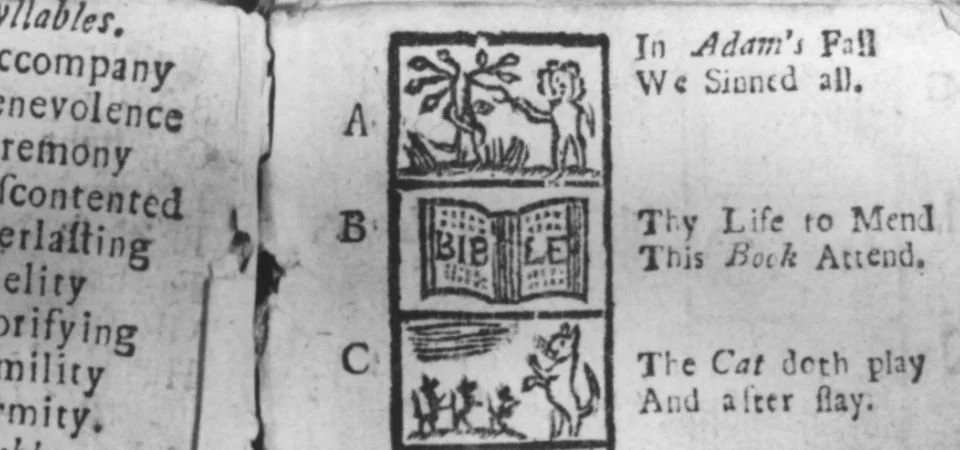
Their first education law was passed in 1642. Heads of households were held responsible for teaching their dependents, apprentices and servants, who were all required to learn English.
The School Code of 1647 became known as “the Old Deluder Satan Law”, because wording in the code blamed Satan for the blurring of religious doctrine through the lens of unknown languages.
Harvard was founded in this era, demanding the same academic rigor.
Dissidents were banished from the Colony (including Roger Williams, who ultimately established the colony of Rhode Island).
Sound harsh? There were those who thought so.
The Puritan’s Charter was revoked by Charles II in 1684, and in 1691 a new Charter replaced it. The second Charter diminished the influence of the Calvinists, and their efforts to return to their previous status were unsuccessful.
““In all, the Bible Commonwealth lasted no more than sixty years.””
Was this harsh, mandatory, religious education of any value?
I say, “Yes.”
The Massachusetts educational goals became a standard for schools in other colonies, and many established their own colleges.

John Calvin
The written word became seen as the ticket to freedom. And the American Revolution benefited from it.
Evidence of literacy can be found in documents from the time, especially in the Declaration of Independence and the Constitution. Political knowledge and thought was at an all-time high.
I don’t attribute these outcomes to compulsory education laws, but I see them as the product of the love for learning, which was seen as a key to freedom from tyranny.
So here’s my question. Is this thirst for knowledge still alive in America?
If so, how can we nurture it?
Samuel L. Blumenfeld author of “Alpha-Phonics: A Primer for Beginning Readers”
I learned this from Sam Blumenfeld, the author of Alpha-Phonics and How to Tutor.
Before Sam created his tutorial books, which have helped thousands of homeschool families to teach their children the three R’s, he spent many years researching and writing about the history of public education.
Follow me, as I continue to learn from this great educator.

Fines Levied on Truant’s Parents
What I learned from Sam, #1
Fines levied on parents of truants?
“What fines?” you may ask.
“For skipping school?”
“That’s tyranny!”
“We’ve got to do something about this!”
But where?
When?
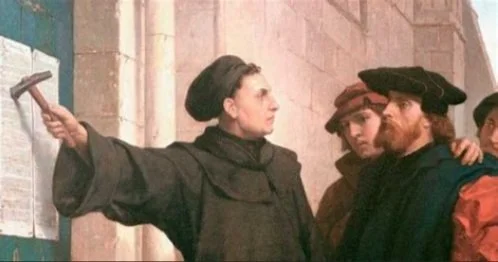
Martin Luther
Believe it or not, the first example of compulsory school attendance was in Württemberg, Germany in 1559.
It was Martin Luther who encouraged the development of government schools for the purpose of moral instruction. These schools required religious instruction from the Bible, and if students did not attend school, their parents were fined.
John Calvin and the Genevan School System
John Calvin developed the Genevan school system, as a way to train teachers and students in the “New Religious Order” of the Reformation.
Further still, Calvin’s model was used for the development of Puritan educational standards in the Massachusetts Bay Colony.
Even the laws and courts were expected to foster and maintain the external worship of God; to defend sound doctrine; and to adapt Christian conduct to human society.

John Calvin
And teachers used the Bible to teach how.
Samuel L. Blumenfeld author of “Alpha-Phonics: A Primer for Beginning Readers”
I learned this from Sam Blumenfeld, the author of Alpha-Phonics and How to Tutor.
Before Sam created his tutorial books, which have helped thousands of homeschool families to teach their children the three R’s, he spent many years researching and writing about public education.
As a proponent of home-schooling, I guess I need to vamp up my own education. So I’ve begun to read some of his works.
I’ll let you know what else I learn. (Just the facts, of course.)

Read to your Children & Around the World with Madeline
Following Madeline around the World
“In an old house in Paris that was covered with vines
Lived twelve little girls in two straight lines.
In two straight lines they broke their bread
And brushed their teeth and went to bed.
They left the house at half past nine –
In two straight lines in rain or shine-
The smallest one was Madeline.”
Amid the quaint illustrations of 12 little girls in two straight lines, and towering landmarks from around the world, are stories of adventure and excitement. Rhyming words draw the attention of the listening child. A series of books follow Madeline’s travels. Paris, London, Rome, and even America provide the landscapes for her fun and sometimes dangerous escapades.
Reading aloud to children is essential. Anyone can list the advantages. Many have adopted the tradition of bedtime stories, story hour at their local libraries, or audiobooks and read-alouds on YouTube. These precious hours, however, are limited.
So why not choose the best of children’s books. Add other educational goals to your list. Geography and history lessons can be seamlessly breached by simply guiding the child through the loveliest of tales.
Travel the world with Ludwig Bemelmans’ Madeline collection.
“All aboard!”


