

Be a Hero – Teach a Child to Read!
The Alpha-Phonics Blog

The Grandmother Who Taught Three Generations to Read
This is the testimony of a classically-trained Grandmother who recommends Alpha-Phonics for teaching reading.
(from Mary Beck Rutkowski, September 2021)
I was blessed to hear this grandmother’s story. She granted me the privilege of sharing her memories here, which I’m sure you will enjoy as much as I do.
““The public schools here were much more advanced into the weakness and failed methods of teaching- so it seemed we were in ‘reverse’ gear, so to speak.””
Laying the Background
“I attended Catholic Parochial school on Long Island, NY, where I was born. Excellent education and though I’d never heard it called as being the ‘classical’ method, it was exactly that.
“Memorization in every subject -rules of grammar, parts of speech, diagramming sentences, — Multiplication tables, addition and subtraction, factors, decimals, percentages, ratio and proportion, square root… History – names of countries, their general history – boundaries, wars, and causes. Geography – oceans, rivers, lakes, mountain ranges…. On and on. As in the Classical trivium, memorization was key.

Mary Rutkowski’s old high school
“After grammar school, I attended a Catholic high school. Sadly, it was not anything like I had expected. Nothing like the follow-up to the first level of the Classical method. I took 2 years of Latin, a year of French and did very well in both. English, even in grammar school, was my favorite and best class – I received the graduation award in English. Competed in spoken French in a NY state-wide competition and scored 6th. Won speech competitions. All this is to lay the background of how, where I was educated to further define what my interests were and where I was at my happiest and my best.”

Mary Beck Rutkowski
Moving Forward
“Please, I will believe you do not take it as bragging. My first child, a daughter, attended our local public school – circa 1967. At that time, the public schools were fairly ‘ok’ and she had a superb Kindergarten teacher, a marvelous lady, ‘Old School’ in every way. She then went on to first grade, another fine teacher. Our son followed 3 years later and did well.
“In 1968, we moved from Long Island to northern Idaho, and that is where we have lived since. The public schools here were much more advanced into the weakness and failed methods of teaching – so it seemed we were in ‘reverse’ gear, so to speak.”
Avoiding the Pitfalls of Public Education
“There was some talk of bringing in ‘sex education’ !!! The other pitfalls and errors of ‘Public’ (Government) schooling became increasingly apparent to me, and we finally put them in Christian school. (As many of us know, this choice does not always meet expectations, but it was the best choice available then.) About this time was when I began to hear of Home Schooling. I did a little of this with my children but did a lot more with my Grand Children and even more with my Great Grand Children.”
Meeting Sam Blumenfeld and His Work
“Somewhere during these years, I heard of Mr. Samuel Blumenfeld !!! I read his book, – “NEA – Trojan Horse in American Education” That was such an eye-opener and I went on and read many more of Mr. B’s books and whatever was available then. He came through Spokane WA on a speaking tour and of course, it was beyond superb.

“It was customary that the host state would take the guest speaker out for dinner – we did and somehow, it was my good fortune to share a small table with Mr. B. He talked about the proper way to teach Reading, Phonics and I ordered his teaching materials – “Alpha-Phonics”.
From Alpha-Phonics to the 6th year McGuffey Reader
“I have used phonics over the years with children, Grands and Great Grands… have taught my Great Grandson to read just over the last year or so. He now reads everything he sees and can read from the 6th year McGuffey Reader. I gave away my original copy of Alpha Phonics to one granddaughter. Quickly ordered another one.”
Commitment to Alpha Phonics
“Alpha Phonics! A simple, accurate and easily understood method of teaching children how to read. It’s a happy thing to see students quickly learn and to enjoy it!
“It is a sad thing to think of little eager minds being taught the senseless, useless “Look, Say’ nonsense. Alpha Phonics teaches the Alphabet; that every letter has a sound; the vowels are taught and the sound/sounds of each one. Slowly, in perfect sequence, consonants are merged with vowels to form simple, one syllable words and moves on easily to more syllables per word.”
“Children learn, like and enjoy it because it makes sense, satisfies the mind and the thrill and excitement of being able to actually see the sound symbols and know what they mean ! And then to progress on to many words of many syllables! I have taught children, Grandchildren and now Great Grandchildren the sweet delight of knowing how to read easily! Out of the darkness, the confusion. Thank You, Sam Blumenfeld for all your fine work!”
I Agree
I not only agree with Mrs. Rutkowski’s raving descriptions of Alpha Phonics, but I share the same results.
When using Alpha Phonics, students are actually reading simple words almost immediately, and simple sentences by lesson 3 (which can even be the first day). No time is wasted on frivolous busy work.
Many testimonies have said the same. One mother once wrote to us, quoting her happy daughter who had barely begun the Alpha Phonics course, “Oh, Mommy!” she said, “I AM READING!”
And, I’m certain that she was.

Reading War Champions & How to Teach Reading – Flesch & Blumenfeld
““According to the U.S. Department of Education, 54% of U.S. adults 16-74 years old – about 130 million people – lack proficiency in literacy, reading below the equivalent of a sixth-grade level.” ”
How can we stand still when the minds of our children are being stolen, right in front of our eyes?
Read the quote again.
More than half of our adult population reads BELOW THE EQUIVALENT OF A SIXTH GRADER!!
Uneducated minds are moldable minds.
People become listeners rather than readers.
Information is biased.
Censorship is at an all-time high.
Voices are being silenced.
Add it up!
Be a hero.
Teach a child to read.
How?
The same problem was addressed in the 1950’s when a humble grandfather began a summer project. He decided to teach his grandson (Luke) to read. They started with a list of 72 lessons (which the grandfather later published). The following information is quoted from the foreword of his book, Why Johnny Can’t Read: and what you can do about it, by Rudolf Flesch, 1955.
“Luke learned the sounds of 5 short vowels and 17 simple consonants, and began reading words like jam, nip, wag and hop. The lists went on to cover words with other sounds and spellings and two or more syllables: chipmunk, kangaroo, and snowball. The last list included liberty, independence and blueberries.
Six weeks later, at a Chinese restaurant, Luke read his fortune cookie to his proud family. “Careful planning will bring rich rewards.””
How could Luke learn to read so quickly? His grandfather had used a foolproof method of teaching based on the alphabetic code. With few exceptions, all English words are spelled by this code, which consists of fewer than 200 letters and letter groups, each standing for one or more of the 44 sounds in English. Once a child has learned this code, he can read.”
Samuel Blumenfeld took the work of Rudolf Flesch to heart. He began addressing the illiteracy problem in his own writing. Finally, he consolidated his work into a primer. That text, Alpha-Phonics: A Primer for Beginning Readers, contains 128 lessons. I have used this book to teach reading many times. I have taught my own children and some of my grandchildren, as well as children from the “disabled” population, including a child who was diagnosed with an autism-spectrum disorder and a 12-year-old girl who had been called dyslexic and was not reading. (She learned in about three months). When I finish teaching the 128 lessons, I move to a first chapter book. I remind, as needed, about the sounds contained in words as we read together. For example, I will make statements like, “in this word the ea says e (making the short e sound); or, “in this word the ai says a (making the long a sound).
You can do it too.
So, let me say it again.
Be a hero! Teach a child to read.
There is no time like today.

The Great Phonics Exodus was Followed by Mass Illiteracy
What I learned from Sam, #6
While reading another of Sam Blumenfeld’s books (The New Illiterates: And how to keep your child from becoming one, 1973 and 1988), I came across an intriguing quote. When responding to the high percentage of “functional illiterates” among inmates, Chief Justice Warren said this:
““The percentage of inmates in all institutions who cannot read and write is staggering. The figures on illiteracy alone are enough to make one wish that every sentence imposed could include a provision that would grant release only when the prisoner has learned to read and write.””
Sam documents what happened to American literacy rates when phonics instruction was replaced by look-and-say methods.
For example, do you know that…
During the War in Vietnam there were so few recruits who met the military’s literacy standard that Defense Secretary McNamara was required to change the policy? that recruits with the equivalent of a 6th grade education were allowed in? that McNamara started a pilot program providing reading and writing classes? And that, interestingly enough, the chosen program was phonics instruction?
Or that Dr. Grant Venn, Assistant United States Commissioner for Vocational and Adult Education was quoted as saying, “Illiteracy is really a much greater functional handicap than the loss of limbs.”?
Or that The Congressional Committee on Education and Labor (1969) claimed that “one out of every four students nationwide had significant reading deficiencies,” and that “in large city school systems up to half of the students read below expectation.”?
Or how about the fact that The New York Times (May 20, 1970) reported that “half of the nation’s adults may lack the literacy necessary to master such day-to-day reading matter as driving manuals, newspapers and job applications, according to a study just published at Harvard University.”?

Child with Alpha-Phonics book
And that even the well-loved CBS news anchorman, Walter Cronkite, wrote in Signature Magazine (May 1970), that many who can’t read depend on news broadcasts for staying informed, and that since the TV news gives such an abbreviated version of stories (not nearly what a reader could learn from more complete documents), the nation-itself was in crisis? “The result,” he said, “is a genuine crisis in communication. Since a democracy cannot flourish if its people are not adequately informed on the issues, the problem becomes one of the nation’s survival.”
And the problem continues…
““According to the U.S. Department of Education, 54% of U.S. adults 16-74 years old –about 130 million people – lack proficiency in literacy, reading below the equivalent of a sixth-grade level.””
The solution, says Sam, comes through a return to systematic phonics instruction. This is not to be confused with what Rudolf Flesch (Why Johnny can’t Read, 1955) described as fake phonics.
Systematic phonics teaches the letter sounds, and letter-sound combinations, as they are blended to make whole words. It trains the eyes to move from left-to-right across words and sentences in a process called “tracking”.
This is the method Sam uses in his textbook, Alpha-Phonics: A Primer for Beginning Readers.
Samuel L. Blumenfeld author of “Alpha-Phonics: A Primer for Beginning Readers”
Please follow my blog as I travel through the findings of reading instructors such as Sam Blumenfeld, Rudolf Flesch, myself and others.
Then join the battle for teaching American children to read again.
You’ll be a hero for sure!

Learning Before We Teach
Sam Blumenfeld late in life
What I learned from Sam, #5
Samuel Blumenfeld (author of Alpha-Phonics: A Primer for Beginning Readers) was an independent thinker on a solitary quest, and a master at research. (The indexes of his books will show this.)
Devoted to improving American literacy, he became a dedicated activist for education reform.
His research extended outside of libraries and into classrooms, where he observed students in their school environments. He was compassionate and dedicated.
I’d like to exhibit the same autonomy, compassion and dedication in my own work, not only following Sam’s model, but passing the flame to a new generation, knowing that the battles over the control of American minds continue today.
I hope to create my own due diligence and become increasingly well-informed, not only about the history of American education, but about its current state and its potential future.
(Due diligence is a term which is often used in the investment world. Before choosing to invest, it is considered a responsible first step. Since I have resolved to invest my future energy into the guiding of young minds, then this is how I must apply myself.)

Page from “Of Plimoth Plantation”
Here’s an example:
When I read Sam’s account of zealous educational demands placed on early Massachusetts families, I remembered reading “Of Plimoth Plantation”. This book was written by William Bradford, the second governor of the Plymouth Colony.
I hoped that if I revisited that book, I would find examples of the thoughts of the day, which would demonstrate why the Puritans were so adamant about perpetuating their faith, and about developing schools and courts to defend it. My short journey back to the book proved successful. Skimming the pages, I read his descriptions of the duties of the Christian, in the defense and preservation of his faith. These were amplified by memories of martyrdom, stemming from the Reformation.
I recommend this book to anyone who wishes to learn and teach about the history of the Christian faith in America.
(Some editions maintain the original text. These are difficult to read since Bradford lived prior to Noah Webster’s standardization of English spelling. Personally, I distrust modern interpretations, so I recommend reading old and new side-by-side.)
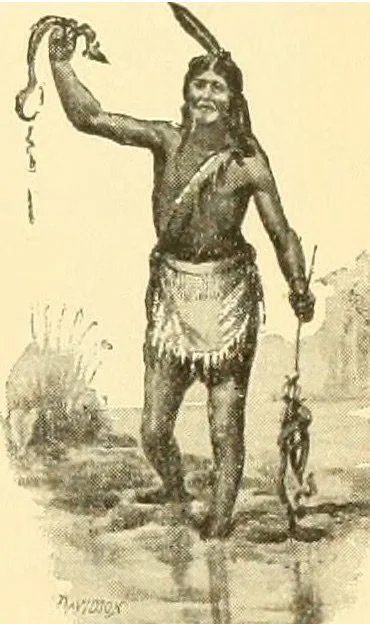
Squanto (c. 1585-1622), Native American of the Patuxet tribe
Delve in and learn from original accounts, such as stories about relations with native inhabitants, and tales about the first Thanksgiving and the Indian guide Squanto. As the expression says, get it “straight from the horse’s mouth.”
With your due diligence and mine, we can continue in that arduous task of educating young American minds.
Let’s work together and learn before we teach.
Samuel L. Blumenfeld author of “Alpha-Phonics: A Primer for Beginning Readers”
I learned this from Sam Blumenfeld, the author of Alpha-Phonics and How to Tutor.
Before Sam created his tutorial books, which have helped thousands of homeschool families to teach their children the three R’s, he spent many years researching and writing about the history of public education.
Follow me, as I continue to learn from this great educator.

Old Foes & New Conflicts in American Schools
What I learned from Sam, #4
New Battles in an Old Conflict
Educational battlegrounds, in our present-day public schools, stem from similar conflicts from our Colonial days. Originally, Massachusetts Puritans enforced Biblical teaching in support of a Calvinistic worldview. Eventually, these beliefs were challenged by Unitarian deism. Calvinists recognized the doctrine of the Trinity, but Unitarians rejected Biblical teaching in the interest of “reason”.

The Age of Reason by Thomas Paine
Thomas Paine, the author of “Common Sense” (the pamphlet known for swaying Colonial opinion in the interest of independence from Great Britain) also wrote a book titled, “The Age of Reason” which defends deism over Christianity, and appears to be equally influential.
The knowledge of this continuing battle is crucial to our decisions regarding the education of our children. We must be vigilant in our examination of ALL the teachings presented in our schools and evaluate their outcomes.
Choosing how to educate our children should be done knowledgably, not blindly.
Samuel L. Blumenfeld author of “Alpha-Phonics: A Primer for Beginning Readers”
Samuel Blumenfeld has provided pages upon pages of information about the history of American schools. He teaches much about the philosophies found there. I recommend his work to those interested in this history.

Legislating Religion in New England
What I learned from Sam, #3
In the year 1620 a group of Puritans set sail from Plymouth, England, on a venture for freedom in the New World.
They were armed with utopian ideas, hoping to escape from post-Reformation tyrants. They wanted to be self-governed, and for their churches to be protected by that government.
By 1630, survivors had established the Massachusetts Bay Colony, where educational standards were set high and rigidly enforced. They adopted the Genevan system which was developed by John Calvin and based on his, “Institutes of the Christian Religion”. They hoped to prepare their families for survival in all situations.
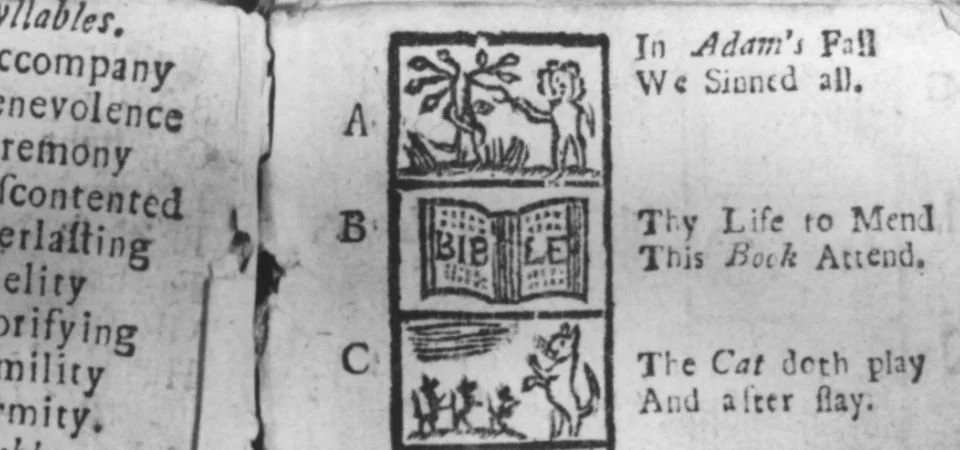
Their first education law was passed in 1642. Heads of households were held responsible for teaching their dependents, apprentices and servants, who were all required to learn English.
The School Code of 1647 became known as “the Old Deluder Satan Law”, because wording in the code blamed Satan for the blurring of religious doctrine through the lens of unknown languages.
Harvard was founded in this era, demanding the same academic rigor.
Dissidents were banished from the Colony (including Roger Williams, who ultimately established the colony of Rhode Island).
Sound harsh? There were those who thought so.
The Puritan’s Charter was revoked by Charles II in 1684, and in 1691 a new Charter replaced it. The second Charter diminished the influence of the Calvinists, and their efforts to return to their previous status were unsuccessful.
““In all, the Bible Commonwealth lasted no more than sixty years.””
Was this harsh, mandatory, religious education of any value?
I say, “Yes.”
The Massachusetts educational goals became a standard for schools in other colonies, and many established their own colleges.

John Calvin
The written word became seen as the ticket to freedom. And the American Revolution benefited from it.
Evidence of literacy can be found in documents from the time, especially in the Declaration of Independence and the Constitution. Political knowledge and thought was at an all-time high.
I don’t attribute these outcomes to compulsory education laws, but I see them as the product of the love for learning, which was seen as a key to freedom from tyranny.
So here’s my question. Is this thirst for knowledge still alive in America?
If so, how can we nurture it?
Samuel L. Blumenfeld author of “Alpha-Phonics: A Primer for Beginning Readers”
I learned this from Sam Blumenfeld, the author of Alpha-Phonics and How to Tutor.
Before Sam created his tutorial books, which have helped thousands of homeschool families to teach their children the three R’s, he spent many years researching and writing about the history of public education.
Follow me, as I continue to learn from this great educator.

Who Taught George Washington?
What I learned from Sam, #2
Who taught George Washington?
How about Benjamin Franklin?
Thomas Jefferson?
Do you care to guess?
Lawrence A. Cremin (author of “American Education: The Colonial Experience 1607-1783”) describes the signers of the Declaration of Independence and of the U.S. Constitution as a hodge-podge, “It is clear that the group is a collective outcome of provincial education in all its richness and diversity.”
According to Cremin, of the 56 signers of the Declaration, 22 came from provincial colleges, 2 from an academy in Pennsylvania, and the rest represented “every conceivable combination of parental, church, apprenticeship, school, tutorial and self-education, including some who studied abroad.”

Washington at the Constitutional Convention
Who Taught the Signers of the Declaration of Independence
14 were from provincial colleges, one from the Newark Academy, and the others “spanned the same wide range of alternatives.”
The founders of our country were the product of what Sam Blumenfeld describes as, “the freest conditions possible.” George Washington was taught by his father and a half-brother. Benjamin Franklin learned to read from his father, and he attended a private school for writing and arithmetic. Thomas Jefferson studied Latin and Greek under a tutor.

Newark Academy
““Of the 117 men who signed the Declaration of Independence, the Articles of Confederation, and the Constitution, one out of three had had only a few months of formal schooling, and only one in four had gone to college.””
So now you know who taught George Washington.
Samuel L. Blumenfeld author of “Alpha-Phonics: A Primer for Beginning Readers”
I learned this from Sam Blumenfeld, the author of Alpha-Phonics and How to Tutor.
Before Sam created his tutorial books, which have helped thousands of homeschool families to teach their children the three R’s, he spent many years researching and writing about the history of public education.
Follow me, as I continue to learn from this great educator.

Fines Levied on Truant’s Parents
What I learned from Sam, #1
Fines levied on parents of truants?
“What fines?” you may ask.
“For skipping school?”
“That’s tyranny!”
“We’ve got to do something about this!”
But where?
When?
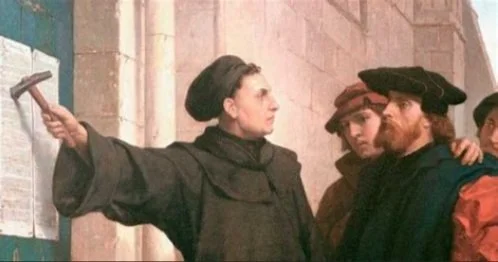
Martin Luther
Believe it or not, the first example of compulsory school attendance was in Württemberg, Germany in 1559.
It was Martin Luther who encouraged the development of government schools for the purpose of moral instruction. These schools required religious instruction from the Bible, and if students did not attend school, their parents were fined.
John Calvin and the Genevan School System
John Calvin developed the Genevan school system, as a way to train teachers and students in the “New Religious Order” of the Reformation.
Further still, Calvin’s model was used for the development of Puritan educational standards in the Massachusetts Bay Colony.
Even the laws and courts were expected to foster and maintain the external worship of God; to defend sound doctrine; and to adapt Christian conduct to human society.

John Calvin
And teachers used the Bible to teach how.
Samuel L. Blumenfeld author of “Alpha-Phonics: A Primer for Beginning Readers”
I learned this from Sam Blumenfeld, the author of Alpha-Phonics and How to Tutor.
Before Sam created his tutorial books, which have helped thousands of homeschool families to teach their children the three R’s, he spent many years researching and writing about public education.
As a proponent of home-schooling, I guess I need to vamp up my own education. So I’ve begun to read some of his works.
I’ll let you know what else I learn. (Just the facts, of course.)

Read to your Children & Around the World with Madeline
Following Madeline around the World
“In an old house in Paris that was covered with vines
Lived twelve little girls in two straight lines.
In two straight lines they broke their bread
And brushed their teeth and went to bed.
They left the house at half past nine –
In two straight lines in rain or shine-
The smallest one was Madeline.”
Amid the quaint illustrations of 12 little girls in two straight lines, and towering landmarks from around the world, are stories of adventure and excitement. Rhyming words draw the attention of the listening child. A series of books follow Madeline’s travels. Paris, London, Rome, and even America provide the landscapes for her fun and sometimes dangerous escapades.
Reading aloud to children is essential. Anyone can list the advantages. Many have adopted the tradition of bedtime stories, story hour at their local libraries, or audiobooks and read-alouds on YouTube. These precious hours, however, are limited.
So why not choose the best of children’s books. Add other educational goals to your list. Geography and history lessons can be seamlessly breached by simply guiding the child through the loveliest of tales.
Travel the world with Ludwig Bemelmans’ Madeline collection.
“All aboard!”


