PHONICS Success in the News: What the “Mississippi Literacy Miracle" Teaches Us About Reading Instruction
For decades, national education discussions operated under a bleak assumption: low-income or traditionally underfunded school districts were pre-destined to fall behind in reading proficiency. Mississippi changed that story completely.
In September 2026 a Fox News Interview on the Mississippi Literacy Miracle with Governor Tate Reeves discussed how the state executed a landmark turnaround—climbing from 47th place in 4th-grade reading in 2015 to 9th place overall, and securing top-tier rankings when adjusted for student demographics. This remarkable transformation offers a clear roadmap for how structured literacy can transform student outcomes nationwide.
Inside the Mississippi Education Reforms
The foundation of Mississippi's turnaround began with comprehensive legislative reforms focused on early literacy. Rather than lowering benchmark standards, state leaders raised expectations and mandated proven, structured approaches in early elementary classrooms.
Key pillars of the state's literacy strategy include:
The Literacy Promotion Act: Mandated early literacy screeners and established a third-grade reading requirement to ensure students master foundational decoding before advancing to complex subjects.
Statewide Educator Training: Re-trained elementary educators in explicit, systematic phonics instruction rooted in cognitive research.
Accountability and High Expectations: Maintained high standards across every school district, demonstrating that children from every background can excel when given proper instruction.
Expanding School Choice & Access: Beyond reading instruction, Mississippi introduced targeted school choice options for special-needs students and opened public charter schools in underperforming districts to drive accountability across the board.
Achieving More with Less: Mississippi accomplished this massive turnaround on a modest budget—spending roughly $11,000 less per pupil than higher-spending states like Massachusetts, proving that clear, evidence-based policy matters far more than bloated administrative budgets.
Leadership Spotlight: Governor Tate Reeves

Mississippi Governor Tate Reeves, champion of early literacy reform and structured phonics instruction
Mississippi Governor Tate Reeves, who previously served as Lieutenant Governor during the initial passage of the state's literacy reforms, has championed structured literacy and accountability throughout his tenure. Born and raised in Florence, Mississippi, Reeves earned a degree in economics from Millsaps College before entering public service.
Reflecting on the dramatic rise in student achievements, Governor Reeves emphasized the power of setting high expectations for students:
"While a lot of other states around the country are lowering standards, we've done the exact opposite. We have raised standards... and Mississippians have done exactly what I expect... when you raise the level of expectations, they've risen up and met those increased expectations."
He further highlighted that strong, structured literacy policies deliver equitable progress across all demographics:
"If you have good strong reforms and good strong policies, you implement them properly, you ensure that there's accountability, then good things happen for kids across socioeconomic factors."
The success in Mississippi proves what literacy advocates have long maintained: when children are taught using explicit, systematic phonics rooted in reading science, every child can learn to read fluently.
The Results: Exceptional Progress Across Demographics
The impact of these reforms was felt across every student group, challenging long-held assumptions about funding and regional performance:
Black 4th Graders Lead nationwide Growth: Black students in Mississippi jumped from ranking 45th nationally among their peers in 2013 to outperforming 4th graders in Massachusetts. A Black child in Mississippi is now 2.5 times more likely to be proficient in reading by 4th grade than one in California or New York.
#1 Nationally for Hispanic Students: Mississippi’s Hispanic 4th graders now rank #1 in the nation in reading proficiency compared to their nationwide peers.
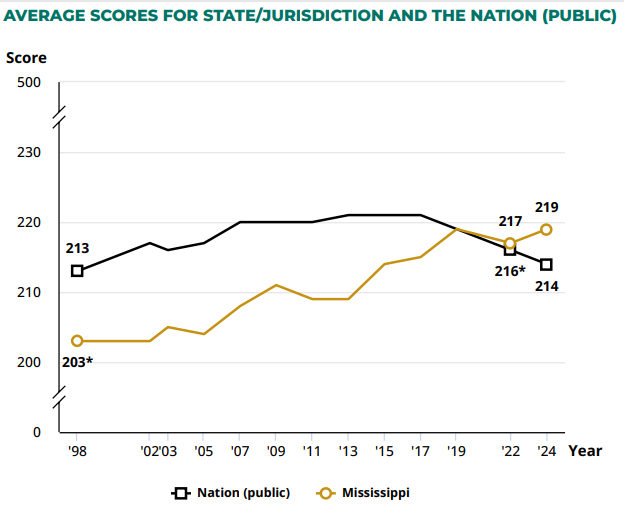
Figure 1: This official NAEP line graph visually confirms Mississippi’s historic rise, climbing from an average score of 203 in 1998 (significantly below the nation) to 219 in 2024 (significantly above the national average). Source: National Center for Education Statistics (NCES), 2024. Note: The 2024 report represents the most recent data available; the next nationwide NAEP assessment is scheduled for spring 2026, with results anticipated in late 2026 or early 2027.
“The data makes one thing undeniably clear: reading output isn’t dictated by race or zip code—it is determined by the METHOD of INSTRUCTION. The true line of distinction in literacy metrics isn’t demographic; it’s the gap between structured phonics-based instruction and whole-word guessing.”
What is Phonics-Based Instruction?
Phonics-based instruction is built on the understanding that letters in an alphabet represent specific speech sounds.
As students learn the specific sounds that individual letters (or letter combinations) represent, they simultaneously practice blending those sounds to decode familiar as well as unfamiliar words.
By mastering these sound-spelling patterns step-by-step, readers build the automatic word-recognition skills necessary for long-term reading comprehension and fluency.
What is the Science of Reading?
The Science of Reading results from rigid scientific experiments that use fMRI technology to compare different teaching methods and their effectiveness.
Here’s what Brain Scientists Have Reported:
Reading Changes the Brain: Humans are born with the ability to speak, but not to read. Learning to read physically builds new connections in the brain to link what our eyes see directly to what our ears hear.
The "Letterbox" Spot: Brain scans show that as children learn to read, a specific area on the left side of the brain adapts to instantly recognize letter shapes and patterns.
Sounding Out Comes First: The brain processes words like an assembly line. It must first master sounding out letters (decoding) before it can recognize words automatically by sight.
Guessing Confuses the Process: Relying on picture clues or context guessing uses the wrong side of the brain for language, slowing down progress instead of building strong reading pathways.
Anyone Can Teach It: Because learning to read follows a step-by-step biological process, parents and tutors can successfully guide a child using simple, explicit phonics—no degree required.
What is Structured Literacy?
Structured Literacy applies the key insights learned through the Science of Reading.
Core Elements Taught in Structured Literacy
Phonology (Phonemic Awareness): Recognizing and manipulating the individual speech sounds (phonemes) in spoken words.
Sound-Symbol Association (Phonics): Connecting spoken sounds directly to written letters and letter patterns (graphemes).
Syllable Instruction: Learning the six common English syllable types to accurately decode multisyllabic words.
Morphology: Studying word roots, prefixes, and suffixes to understand word meanings and structures.
Syntax: Understanding grammar, sentence structure, and mechanics to build comprehension.
Semantics: Developing vocabulary and understanding the meaning of written text in context.
Key Instructional Principles
Explicit: Teachers directly explain every concept clearly rather than expecting students to infer or discover rules on their own.
Systematic & Cumulative: Lessons build step-by-step, starting with basic sound-letter rules and gradually introducing complex patterns as earlier concepts are mastered.
Diagnostic & Responsive: Progress is continually monitored so instruction can be adapted immediately to ensure full mastery before moving forward.
CALL TO ACTION
Raise the Bar in Your State
Drive Literacy Reform
The success in Mississippi isn't a fluke—it's a policy model that can be replicated in any state. Here is how parents, school board members, and community advocates can push for real educational reform:
Advocate for Science of Reading Legislation: Contact state representatives to urge the adoption of statewide legislation mandating explicit phonics and structured literacy in all public elementary schools.
Require Teacher Preparation Reform: Demand that state universities and teacher training programs replace outdated "balanced literacy" methodologies with evidence-based reading instruction grounded in cognitive science.
Implement Third-Grade Reading Standards: Support policies that require early diagnostic screeners and reading proficiency benchmarks before promoting students to upper grades.
Engage Local School Boards: Request transparency regarding the reading curricula used in your school district and advocate for replacing sight-word guessing methods with direct phonics programs.
A Message for Homeschool Parents
Working the “Mississippi Miracle” in your own home
You don't need a public school overhaul to bring the Science of Reading into your living room. Systematic, explicit phonics is the most reliable way to build a confident, fluent reader. And it is SURPRISINGLY SIMPLE!
No Guesswork: Eliminate harmful "cueing" habits like guessing words from picture context. Teach the letter-sound relationships directly.
Mastery-Based Progress: Move step-by-step from simple consonant-vowel-consonant (CVC) words to complex letter combinations.
Proven Tools: Simple, affordable programs like Alpha-Phonics deliver direct phonics instruction without expensive teacher guides or confusing jargon.