Congress Passes Bipartisan Science-of-Reading Act: Legislating Phonics-Based Literacy
While the "reading wars" have historically been fought at local school board meetings and state capitols, federal lawmakers in Washington are officially stepping onto the battlefield. Recent actions in both the House and the Senate demonstrate significant bipartisan momentum behind phonics-based instruction and the broader Science-of-Reading movement.
However, a close look at the mechanics of these legislative efforts reveals an important policy reality: Washington isn't leading this revolution—it's following the states — as shown in the state-by-state policy breakdown below:
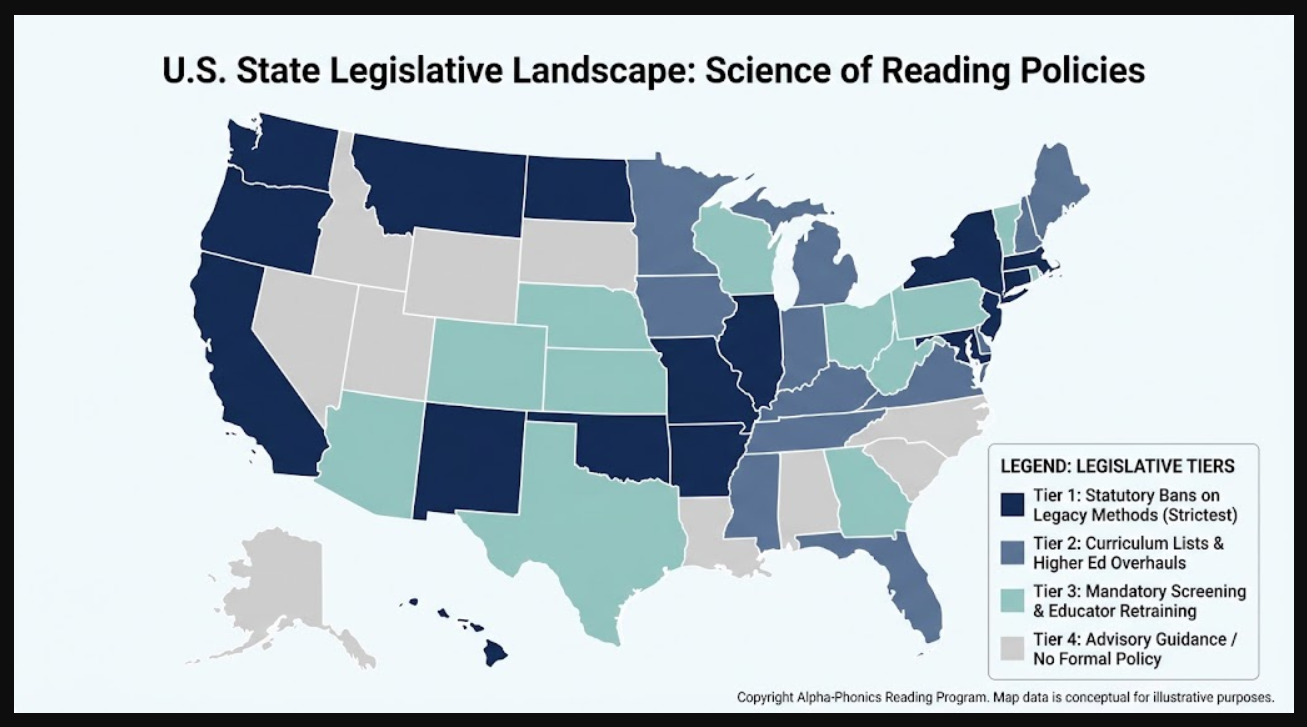
State Legislative Literacy Tracking Map (2026)
The State-Level Landscape: A Four-Tier Breakdown
To understand how far state policy has shifted, we can categorize all 50 states and the District of Columbia by how strictly they mandate structured literacy and phonics instruction in their public schools
Understanding the Four Legislative Positions
1. Statutory Bans on Legacy Methods (The Strictest Approach)
States in this category have taken an uncompromising regulatory stance. Rather than merely encouraging phonics, these laws explicitly prohibit districts from using instructional practices built on the "three-cueing" system—a legacy method that teaches students to guess words using pictures, syntax, or context clues. In many of these states, school districts that purchase non-compliant materials risk losing state reading funds or facing financial audit penalties.
2. Curriculum Lists & Higher Education Overhauls
These states target systemic reform by controlling what enters the classroom at the supply level. State departments of education publish binding "approved curriculum lists" that districts must choose from if they want state funding. Crucially, these laws also target higher education: public colleges and universities are legally required to remove balanced-literacy theories from their teacher preparation programs, ensuring new educators pass a phonetic decoding competency exam before receiving their teaching licenses.
3. Mandatory Screening & Educator Retraining
States adopting this model focus on active classrooms and early detection. Public schools are mandated to conduct universal literacy screeners multiple times a year in grades K–3 to catch reading gaps early. Furthermore, active teachers and elementary principals are required to complete state-funded, intensive professional development grounded in cognitive reading research (such as LETRS training), equipping current educators to transition away from legacy methods.
4. Advisory Guidance or No Formal Policy
A dwindling minority of states have chosen not to issue top-down legislative mandates. These states typically rely on local control traditions, offering advisory guidelines, sample literacy frameworks, or competitive grant opportunities for districts that voluntarily choose to upgrade their reading curricula, while leaving the final choice entirely up to local school boards.
Washington Catches Up
As state-level momentum reached critical mass, federal lawmakers stepped in to align federal spending with the reality on the ground.
The House Action (H.R. 7890): The U.S. House of Representatives passed the bipartisan Science of Reading Act of 2026, sponsored by Rep. Erin Houchin (R-IN) and Rep. John Mannion (D-NY). The bill directly targets the $194 million Comprehensive Literacy State Development (CLSD) grant program, barring federal grant funds from being used on three-cueing strategies and prioritizing districts using phonics-first curricula.
The Senate Companion (READ Act): Lawmakers (like Sen. Bill Cassidy, R-LA) are advancing the READ Act in the Senate. The Senate framework requires states applying for federal literacy grants to demonstrate active, state-level Science of Reading policies.
Under federal law, Washington cannot issue a top-down, national curriculum mandate for local classrooms. Instead, Congress is using financial leverage. By restricting how federal grant dollars can be allocated, federal legislation ensures that taxpayer dollars no longer subsidize instructional practices that state laws are actively outlawing.
Looking Ahead at State & Federal Policy
As federal bills move through the Senate and state legislatures prepare for upcoming sessions, several key shifts are emerging on the horizon:
The Fight Over Implementation Enforcement: Passing a law is one thing; changing daily classroom habits is another. Expect states in Tiers 2 and 3 to move toward Tier 1 by adding audit mechanisms, literacy coaches, and stricter oversight to ensure schools aren't keeping legacy materials on classroom shelves.
Higher Education Accountability: Legislative focus is rapidly shifting toward colleges of education. States are beginning to evaluate university teacher-preparation programs based on their graduates' pass rates on foundational reading exams, threatening to revoke program accreditation for institutions that continue teaching three-cueing theories.
Litigation & Publisher Resistance: Textbook publishers and advocacy groups representing legacy "balanced literacy" programs are increasingly challenging state-approved curriculum lists and statutory bans, arguing that state-mandated textbook lists infringe on local school board autonomy.
Upper-Grade Literacy Interventions: While early legislation focused heavily on grades K–3, upcoming state and federal proposals are expanding intervention mandates into middle and high schools to support older students who missed systematic phonics instruction during early elementary school.
Congress isn't creating the shift toward phonics—it's simply adjusting federal grant structures so national dollars align with the rules states have already written.
Summary
The nationwide transition to the Science of Reading is no longer a localized movement. By tying federal literacy grants to evidence-based instruction and restricting funds for legacy methods like three-cueing, proposed federal legislation aligns national spending with the landmark mandates already passed in over 40 states. As Congress works to finalize these grant guidelines, the message from every level of government is clear: systematic phonics and structured literacy are becoming the universal standard for American reading instruction.
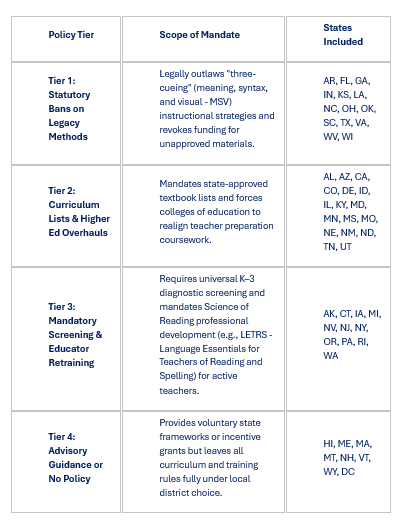
Table categorizing U.S. state literacy laws into four policy tiers, listing key legislative requirements and individual states included in each tier from Tier 1 (Strictest) to Tier 4 (Advisory).