Frank Laubach the Visionary
Maker of Alphabets
A Convicted Murderer, a Columbia Grad, and a Missionary
The Frank Laubach Story — Creating Alphabets
[NOTE: This is an abridged version of the Frank Laubach story as it was told in my book, Dyslexic No More: Saved by the ABC’s (2022).]
Setting the Stage for the Creation of an Alphabet
This is the story about the most unlikely teachers, the most suspicious students, and the most miraculous results. It began in 1930 in the Lanao Province of Mindanao, in the southern Philippines. An ambitious young missionary and his wife had decided on the location for their mission field, but before they left for the Philippines, that aspiring missionary-to-be, Frank Laubach, presented a short speech to a farewell party. He explained why they had chosen Mindanao.
“If I were in a battle, and with no orders from my captain, I would be a coward if I fought where we were winning; I would be a man if I fought where our ranks were thin, and we were losing the battle. We are in a battle for Jesus Christ, to conquer the world, and the ranks are thinnest and the battle hottest in the Orient. So, we are going where we are needed most.” (Frank Laubach)
Upon arrival they were told by Army officers that inexperienced missionaries talking religion would only make matters worse. They didn’t think they would be accepted by the Lanaon people (the Moros). After living several months outside of Mindanao, however, Laubach had established some report with the Moros, and he decided to pursue a more thorough knowledge of the language. He asked an American officer to recommend a teacher.
The recommendation? Pambaya, a convicted murderer who had successfully appealed his case, and thereby escaped a twenty-year prison sentence. (Laubach explains in his memoire that this man eventually, “helped us prepare our dictionary and translate thousands of pages into Maranaw, including the Gospel of Luke and the Book of Acts.”)
Laubach and Pambaya were joined by a Filipino, Donato Galia, who was a master’s level graduate of Columbia Teachers College, and Pambaya began to teach them. They quickly learned that the Maranaw language had never been written, only spoken. So, the three worked together to create a written form of the Maranaw language, and there began the journey.
Creating an Alphabet for the Moros People
The men chose to create an alphabet to represent the sounds of the language (12 consonants and 4 vowels – b, d, g, k, l, m, n, p, r, s, t, ng, a, i, o, u.) They would use the new writing system to publish Maranaw poetry, historical accounts, and other cultural elements of interest. Then, they would teach the people to read.
They devised a system for teaching the alphabet, beginning with three words which contained all the consonants in the language. They were Malabanga, (a town in Lanoa); karatasa (paper); and paganada (to study or learn). Then they broke the words into syllables like this:
Malabanga: /ma/-/la/-/ba/-/nga/
Karatasa: /ka/-/ra/-/ta/-/sa/
Paganada: /pa/-/ga/-/na/-/da/
Next, they began teaching words with those syllables, like ma ma (man); a ma (father); ma la (big), and so on. They developed phonics charts for teaching the alphabet and words.
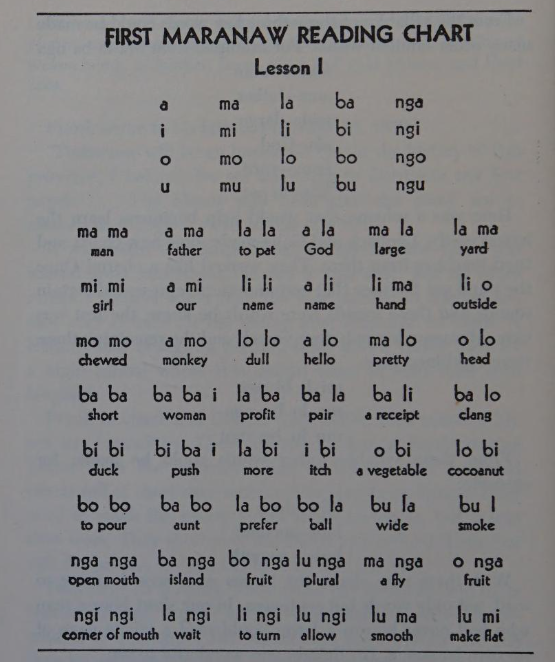
This chart was found in the book, Each One Teach One: Frank C. Laubach Friend to Millions (Marjorie Medary, 1954) retrieved online on July 2, 2026
From Learning the Alphabet to Reading Fluently
Learners would practice reading from the charts, reciting the sounds (phonemes) that corresponded with the markings (graphemes) on the chart. Laubach’s stories, about his varied experiences while teaching reading, imply that the process was simple, and that many learned very quickly. Here is one such account, in which the fluency was still lacking, but the understanding about how words work was established:
“Two Moros just came in to show me how they are learning to read. Very, very slowly but correctly. One read a paragraph. Perhaps in another month he will attain fair speed. He has passed the first and hardest achievement, for he knows that letters can be so pronounced together, that they form themselves into words and convey the ideas he wants to express.” (Frank Laubach)
“It is like a miracle,” Laubach accounted later, “for a man, who never knew a letter, to walk out of our school in an hour able to read a whole page of his own language with Roman letters. We see that miracle happen over and over, every day. But the joy of seeing people learning ten times as fast as they expected to learn, and all set up about their own brilliance does not lose its edge.” (Frank Laubach)
Laubach also noted that his co-laborer, Donato Galia (the Columbia Grad), was reported to have taught nine Moros to read in half an hour.
I felt swept on by a power that I could neither explain nor control. I was a little part of it, and so were all the others. I know it was the spirit of God in a strange new form.” (FrankLaubach)
Laughter & Literacy – The Legacy of Love
Frank Laubach’s work did not stop in the Philippines. He spent 30 years taking literacy around the world with campaigns to areas including Japan, India, Africa, Latin America, Turkey, Thailand, and China. He was blind to race and to religion. He was led by the single desire to bring literacy to “the silent billion”.
Laubach believed that the illiterate masses were imprisoned by their inability to read. Without literacy they had no voice. They were easily swindled by the literate. Enslaved. He worked to set the captives free, and he equated this work with the work of giving sight to the blind.
And joy followed him. He reported great episodes of laughter among learners. One old man thought he was too old to learn to read. Yet, within fifteen minutes he had learned the phonetic Alphabet created for the Moros.
“We kept him roaring with laughter,” reported Laubach.
Once, in a class setting, another learner became so hysterical with laughter, that the class was shut down until he was able to regain his composure.
And that contagious laughter still echoes around the world.