Announcing Alpha-Phonics PLUS: Keeping Pace with the Science of Reading
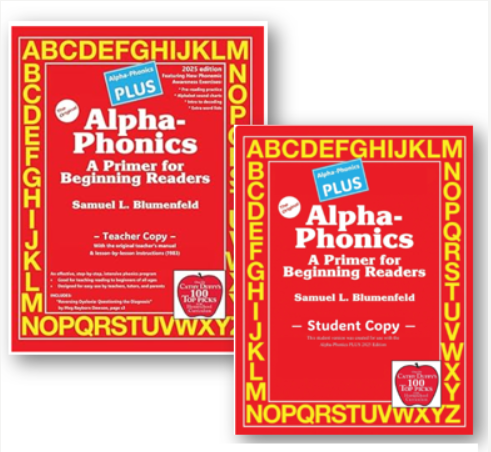
The Alpha-Phonics PLUS, 2025 Edition is now available in both a Teacher and a Student Copy, making this Homeschool Classic available for use in the classroom. Find it on Amazon. You’ll also find our Original 1983 Home-School Version there, at the same unbelievably low price which is has maintained for over forty years.
The new PLUS Supplement was contributed by Meg Rayborn Dawson, author of Dyslexic No More: Saved by the ABC’s (2022). It features Phonemic Awareness Exercises including: Alphabet Sound Charts; Decoding (blending) and Enunciation Drills, extra word lists for the extra-conscientious teacher, and more.
2025 was a productive year for us at Alpha-Phonics. We have successfully completed our newest edition (Alpha-Phonics PLUS) and reestablished our focus on new learners and new learning environments. You may wonder why, after over 40 years of success with our product, we should change anything at all. Let me tell you why.
Transitioning to New Publishers
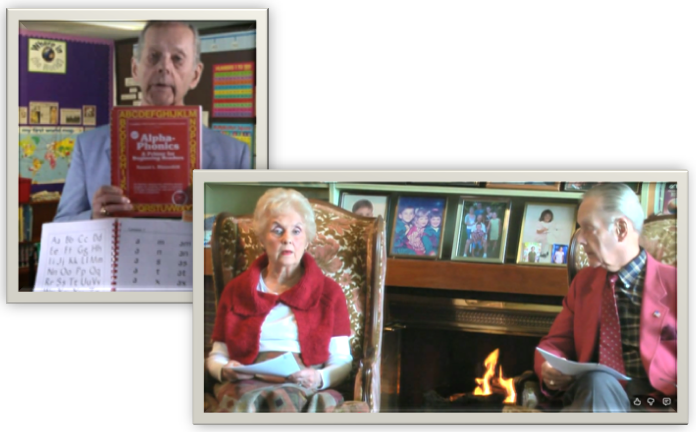
Peter and June Watt were the original publishers of Alpha-Phonics, other books by Samuel Blumenfeld, and a random collection of home-school text books and guides. They also published the Blumenfeld Education Letter. These photos are screenshots from some of their Homemade Marketing Videos (circa 2011), retrieved online February 27, 2026. https://www.youtube.com/@paradigmcoidaho
I have been honored by this opportunity to continue in the legacy of our previous publishers (Peter Watt, 1932-2023, and his wife June, 1932-2018). Two years prior to Peter’s ultimate retirement, he invited me to become involved in the future marketing of Alpha-Phonics. I had worked with Peter and June in the early years, when homeschooling was just beginning to break out across the country, and when our family worked in their basement office.
Samuel Blumenfeld, the author of Alpha-Phonics: A Primer for Beginning Readers, would speak on radio shows about the importance of using an alphabetic approach to teaching reading. Meanwhile, Peter sat by his phone and took orders. The orders were filled from that little office where books were piled, and shelves were used to organize various products, even before the Watts had begun using computers.
Letters of satisfaction arrived in their mailbox, and customers called them over the phone to ask questions about teaching. He and June worked non-stop to maintain the flow of reading curriculum into the hands of home-school adventurers, of which I was one. (I was given the privilege of teaching eight of our nine children to read using Alpha-Phonics.)
The Science of Reading & Phonemic Awareness Instruction
When my children were raised, I began tutoring children who had been unsuccessful at learning to read through their schools. While doing this, I discovered a problem. It was more difficult to teach these students than it had been teaching preschool age children to read. I began studying the writings of Samuel Blumenfeld, as well as other reading specialists as far back as the late 19th century, and this helped me understand why. I learned something quite astounding in the process.
Confirming Instinct with Science
Amid many pages of Sam Blumenfeld’s writings, I discovered a tidbit that stuck with me. He wrote about something which he called a reading reflex. He believed that there was a mental correlation between the type of reading instruction used (systematic, intensive phonics or whole word methods). and the location in the brain where learning took place with that type of instruction. Students learning to read phonetically used one area of the brain to read, and students using a whole-word method used another. Sam assumed that when students’ eyes looked at words, the information was sent to whichever region of the brain they most commonly used to read. This made sense to Sam, long before neuroscientists began observing brains technologically, and it made sense to me when I struggled using phonics-based instruction with students who had already developed a whole-word reflex. Sam’s insight has since been confirmed through scientific laboratories, using functional Magnetic Resonance Imaging (fMRI).
The Science of Reading & Phonemic Awareness Instruction
A leading pioneer in this new technology is Stanislas Dehaene, and his findings have not only confirmed what Sam had intuited, but they became the basis for what is now called the “Science of Reading”.
Dr. Dehaene’s scientific investigations have become the catalyst for the adoption of the alphabetic approach to teaching reading in several of our United States, and those states which have adopted this method are moving up in the ranks of our National Assessment of Educational Progress (NAEP) Reading Report Card, bypassing states which have not yet adopted systematic phonics teaching.
Why the PLUS?
One aspect of this new teaching methodology is the introduction of phonemic awareness. Dr. Dehaene not only discovered that the process of decoding words (phonics) took place in a very specific brain area (which he and his colleagues dubbed the Visual Word Form Area), but he also documented the importance of reading to children, talking with them, and playing word games with them. As a result, reading readiness programs are now focusing on teaching the sounds of the language (phonemic awareness).
The new Alpha-Phonics PLUS supplement provides additional lessons and drills for students who have already developed whole word reading reflexes. Their brains are “retrained”, by replacing the whole word reflex with the phonics reflex. We have added letter sound charts, decoding drills, and additional word lists with this objective in mind. The label of dyslexia is being destroyed by the Science of Reading, one reader at a time.
New Opportunity for Classroom Teaching
As if that were not enough, we have an additional announcement. Alpha-Phonics PLUS can now be used for small group teaching in schools, and we provide a student edition to work hand in hand with the teacher’s edition.
If anyone reading this blog would like me to talk with a group of teachers and/or homeschool parents, and answer questions about our new edition, contact me at (208) 510-8339, or through the Alpha-Phonics.com email system. I hope to return our business to the more personal approach which Peter and June demonstrated to me, and I will gladly answer questions sent through email, or by phone.
Happy New Year!
Shall we call it the Year of the Return to Literacy?